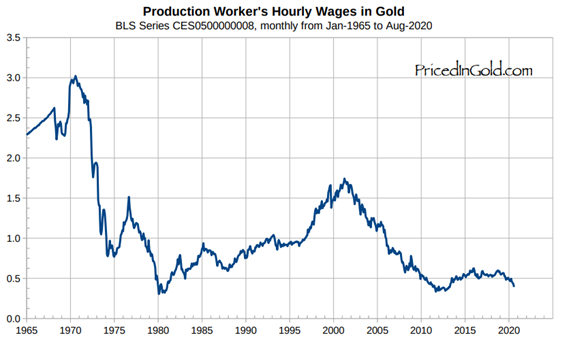
First, let’s get the really bad news out of the way. You’re probably extremely underpaid for what you do. In fact, you probably get paid around one-sixth of the salary that a worker got in 1970 for the same job. There has been a huge real decline in income, masked by fiat currency inflation, meaning many of us are worse off than ever.
This goes a long way to explaining why life has got harder and most households now require both parents to go out to work to keep the family going. A less common occurrence back in 1970.
To look at this another way, to return to 1970, our salaries need to increase by six times. Yes, six times. Imagine that, a world that rewards work and self-sufficiency over clever monetary tricks. Sadly, such a world is not here yet.
The concept of corporations goes back to Roman times and possibly still further. The basic idea is that a group of people got together to form a venture. Normally with profit-bearing motives. The word ‘corporation’ even comes from the Latin, ‘corpus,’ meaning ‘group of people.’ Part of the idea of corporations being that the venture could live on beyond the lifespans of normal people. Corporations really caught on as imperial trade ventures spread further and further afield, growing with the globalisation and taking us to the point today where these huge entities dominate national stock markets and their corporate footprint is everywhere. Most visibly seen in the products we buy and the logos we see all the time.
In terms of the relationship between governments, corporations, and the people, the view seems to be that the government is paternalistically representing the people and that corporations are off to the side regulated and taxed by the government, and people have the choice of whether or not to transact with them. In a way, they are almost considered to be a subset of the people, in the respect that many also own shares in the corporations, either directly or through their pooled investment schemes, like pensions. Also, people believe that the government is voted in by and represents the people, and the people only.
Once governments got you used to the concept of using just one currency in your everyday transactions and got you used to the trust that they were looking after your gold – they began loaning it out and selling it off, often without your knowledge or consent.
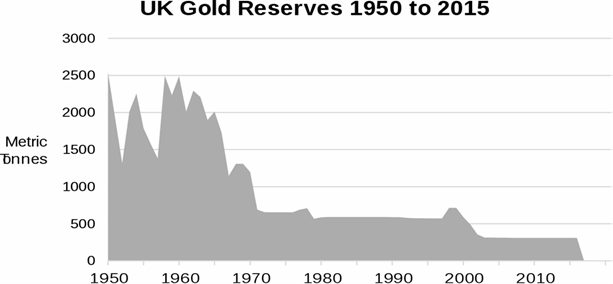
(Chart: source: Wikipedia By Tsange – CC BY-SA 4.0)
Looking at the chart, it’s easy to see the UK gold reserves have declined massively, especially in the 1960s – leading to the famous ‘Pound in your Pocket’ speech by Prime Minister Harold Wilson in 1967, trying to assuage voters that their pound was still worth a pound, as the value plunged against other currencies. A pound of what, Harold? In 1999, the UK decided to sell off over half the nations’ remaining gold reserves, some 400 tonnes. At the time, gold was at the end of a major 20-year bear market, and the price was at an all-time low, a price last seen in the 1970s. The Bank of England, the custodian of the countries’ gold reserves, insists that it was never consulted in the decision, and some leaks, in fact, suggest that many of their staff vigorously opposed the move. They claim that Her Majesty’s Treasury and them alone made the decision. At the time, the Chancellor of the Exchequer was a Mr. Gordon “Golden” Brown, who subsequently became Prime Minister.
Even worse, the huge gold sales and auctions were publicly announced well in advance, thus giving gold dealers the chance to prepare for the glut of gold that was about to be released onto the market, and force the price down still further as a result. The normal strategy is to keep intended government gold sales quiet, then simply conduct the sales on the open market, obtaining the best prices possible, then announce the results afterward.
Why might a government decide to sell off one of the main assets of its people at the lowest price possible? There were rumours and accusations that the gold was sold to prevent top Hedge Funds who had got it wrong gambling on the price of gold from going bust and destroying the worldwide economy, among others.
Regardless of the truth of the rumours, 1999-2002 has subsequently been proved to have been exactly the right time to start buying gold, not selling it; in fact, the value of the gold sold by the UK has risen by over ten billion dollars since that time. This period in gold price history is now referred to as ‘The Brown Bottom.’
While the owning of gold was illegal for US citizens from 1933, the USA sat atop international trade after World War 2, allowing gold convertibility at the same price of 35 dollars an ounce for other nations. This was called the ‘Bretton Woods’ agreement, referring to the location where it was signed. However, partly due to the cost of paying for the Vietnam War, the number of dollars in circulation began rising in the 1950s and 1960s. Nations like France and West Germany seized their chance to exchange their devaluing dollars for the real thing, gold at $35 an ounce. In 1971, the window for exchanging gold was officially closed.
As the current empire, the USA began 1900 with a strong, growing country, an economic powerhouse destined to lead the world, and best of all, their currency was all denominated in gold and silver.
The USA removed its link in gradual phases, but several major milestones stand out in history. The first of these was the creation of the Federal Reserve, in 1913, just before World War One, handing control of the US national currency to private banking interests. To emphasise the importance of this, remember Amschel Rothschild’s quote :-
“Give me control of a nation’s money, and I care not who makes the laws.”
― Amschel Rothschild
James Corbett’s superb “Century of Enslavement – History of the Federal Reserve” video and podcast documentary is highly recommended for the full history of how that happened.
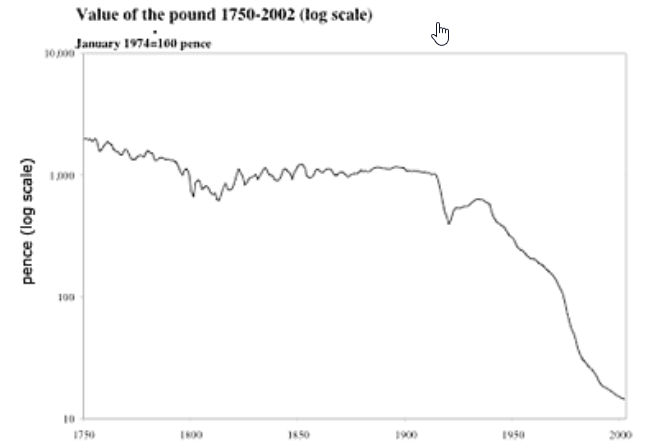
To give you an example of how that paper you have in your wallet, or digital bits on your banking homepage screen have become distended from the real money it once represented, just think of this – A British Pound Sterling was once worth exactly what the words say – A pound in weight of Sterling silver. As of the end of August 2020, the same pound of sterling silver is valued at £282, or $376. That is 0.0035% of its original value.
In 2006-07, originally as a hobby project, I wrote my first book, imaginatively entitled “How to Invest in Gold and Silver.” It was meant just to be a self-published work, distributed to a few friends and relatives, no further than that. However, in late 2007 and early 2008, strange things began to occur in world financial markets again, culminating with the BBC showing footage of people queueing outside Northern Rock, a UK-based bank, patiently waiting their turn to withdraw their savings from the bank in cash. These scenes looked exactly like something being replayed from history, familiar, common even. They were well-documented from a 1907 financial crisis in the USA when the imaginatively-named Knickerbocker Trust got into trouble, and history books tell us decisive action by the financier James Pierpont (J.P.) Morgan saved the day and more commonly-known, the 1930s in the aftermath of the 1929 Wall Street Crash. Only, whereas the BBC was subtly mocking them as fools and playing lots of footage of experts saying they were silly to worry, history showed something written in the book.
Fractional Reserve Banking is responsible for something we all nowadays take as a positive thing because it means we get a day off work. Bank Holidays. The origin of bank holidays is historically based on banks taking a holiday from paying out to customers. They could tally the books during this holiday and ensure that they weren’t technically insolvent from having lent out too much money against deposits. The idea is that, if the bank was insolvent, they could call in a few favours during the day off and be in a position to continue the business, as usual, the next day of opening. If it sounds like something ancient, think again. The whole USA even had an eight-day bank holiday in 1933, after an emergency law was passed to stop more banks from going bust.
The 1964 Disney film “Mary Poppins”, starring Julie Andrews and Dick van Dyke, also demonstrates how a run on a fractional reserve bank works. In one scene, the bank manager sings about funding imperial projects like ‘railways in Africa’ and ‘dams in Egypt.’ The bank then snatches tuppence from a young boy who then shouts, “Give me my money back!” This prompts other bank customers to be concerned about why the bank manager won’t give his money back, and they begin demanding theirs, too, leading to the bank closing the withdrawal counters.
With the withdrawal counters closed, the bank accidentally spills a huge pile of gold coins on the floor, a subtle suggestion, perhaps, to help you realise they do have your money really. As long as all depositors don’t want their money back simultaneously, banks are fine. Trust is key.
The timing of this film is in itself interesting, if one digs a bit deeper. 1964 was a time when the public was beginning to have doubts about American superiority and dominance and with just reason. In 1963, the USA has 93 million silver dollars as security against silver certificates, but by 1964, it had dropped to 22 million. Also, the death of a president in 1963, one who had opposed the selling off of the nation’s silver reserves at $1.29 an ounce (it would be $50 an ounce 16 years later), was another factor in monetary change. In 1965, Lyndon Johnson signed the coinage act, reducing silver content in coins to 40% for half dollars and making the smaller coins, nickels and dimes, an inferior cupro-nickel alloy. Coin collectors and hoarders may be blamed, but we can guess the truth.
In reality, this story is little different to how the Roman Empire and countless others effected their thefts from the populace. Whereas once the bread and circus charade probably involved Gladiators wearing banners proclaiming the newly-debased copper solidus was “as good as gold”, we now have direct imagery hitting the brain. Disney certainly has a chequered history with possible abuse of it’s power that is worthy of special investigation. Then do you remember how 3 is the Magic Number? It seems it is for Disney too.
Fractional Reserve Banking got a large mention in the 1947 film, “It’s a Wonderful Life.” In the film, worried depositors are seen turning up at the local private bank in a panic to withdraw their money. They also turn up to the small Savings and Loan institution run by James Stewart and try to withdraw their money. He makes an impassioned speech explaining that their savings are loaned out to other members of his institution, reminding them that the private bank is not so generous or fair. Customers are unaware of behind the scenes machinations, where the large private bank is trying to put him out of business. He eventually backs up trust in the business with his own money and manages to survive.
There are clear messages in this film, also regarding Usury, large corporations, and community. The USA had suffered many bank runs in the 1930s, as worried depositors took out their dollars to pay for emergencies, or just to retain them as physical savings in their house. It’s estimated that by 1933, 9,000 banks had collapsed, so there’s no doubt this film would’ve meant a lot more to that generation watching it than us today. When it was released, the film was regarded suspiciously by the authorities, even as communist and subversive. It’s still as relevant, though, and well worth watching at least this clip.