A Coin from the Edge of the Sea

Saturday, the coast again.
No plan beyond walking, listening to the detector, letting the ground decide what—if anything—it wanted to give up.

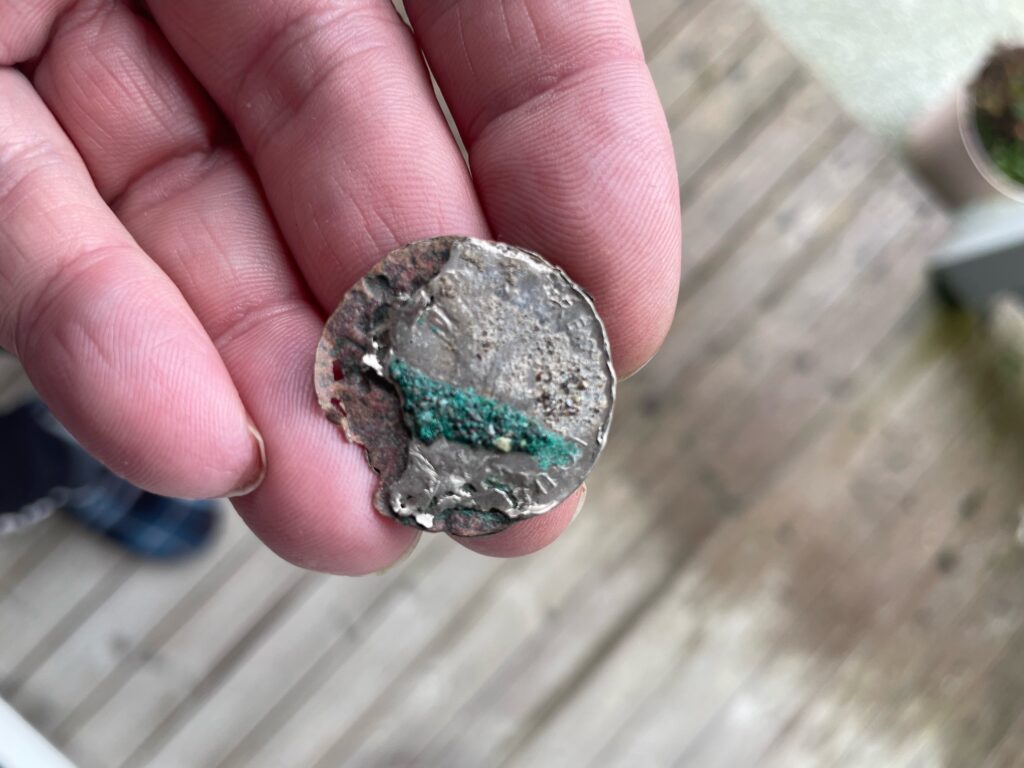
What came out of the sand didn’t look like a coin at first. Just a bent disc, flaking, scarred, almost tired. The kind of object most people would drop back where they found it.

But weight tells its own story.

Once cleaned enough to see structure rather than detail, the deception became obvious. A skin of silver, thin and failing, lifting away to reveal a copper core beneath. The green line—verdigris—cutting through it like a confession finally made under pressure.

This wasn’t damage.
It was design.

A forged silver coin. Almost certainly French. Georgian era. Made not to last, but to pass. Made to move quickly from hand to hand before anyone stopped to test it too closely.

Someone, two centuries ago, held this same object and decided it was “good enough”.

Money on the Move

Coins like this didn’t belong to collectors or kings. They lived in markets, taverns, ports. They moved with sailors, traders, soldiers—people in transit. People who valued speed over certainty.

Silver coinage worked because trust worked. Weight, colour, sound. That was enough. Most of the time.

Clipping the edges, plating copper, reducing fineness—these weren’t anomalies. They were symptoms. Wherever money moves, someone tries to make it lighter without anyone noticing.

This coin survived because it succeeded. For a while.

Eventually it failed, as they all do. The sea finished the audit that merchants once performed by hand.

Found, Not Explained

I don’t know whose pocket this sat in.
I don’t know what it bought, or when it was finally rejected.

What I do know is that it travelled. It crossed hands, borders, and probably arguments. It outlived the person who made it, and the person who passed it on.

Now it sits on a table, silver peeling away, copper exposed, the disguise no longer worth maintaining.

A small object, carried forward by chance, turning up exactly where journeys tend to end—at the edge of the water.

I put it aside with the others.
Not as a lesson.
Just as evidence that the road has always been like this.

I found it where journeys pause—at the waterline, where disguises no longer matter.

Hawick: A Case Study in Capital, Money, and Decline

Hawick provides a clear case study of how a small industrial town once integrated into Britain’s productive and financial system — and what remains after that integration dissolves.

This was not a peripheral settlement. Hawick was deliberately built and connected because it produced. Its Georgian and Victorian architecture reflects capital deployed with confidence: mills, commercial streets, banks, clubs, and river infrastructure designed to serve output rather than appearance.

The town’s economic logic remains visible. Even after industrial contraction, the structure of production, finance, and circulation can still be read in stone and layout.

Hawick was once a mainline railway stop, linking Scotland through England to London. Such connectivity followed volume and output, not policy ambition. The railway’s removal was not the cause of decline but confirmation of it. As production diminished and capital withdrew, infrastructure followed.

Infrastructure does not fail first. It responds to capital flow.


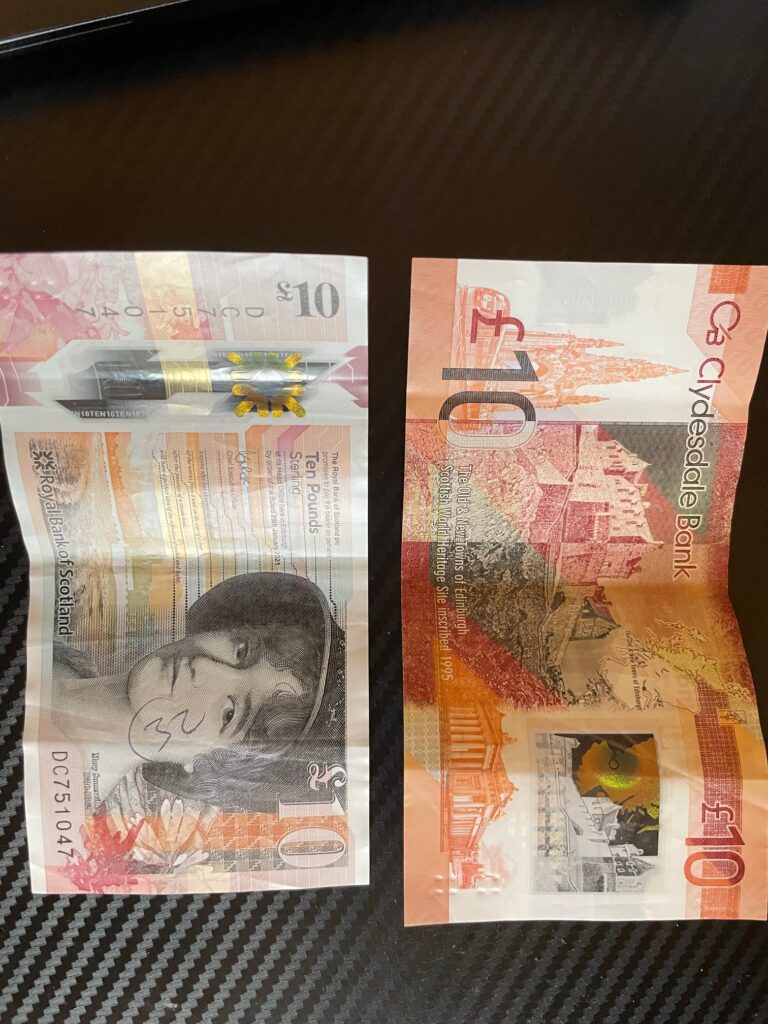
Scottish Banknotes and Residual Issuing Power

Scotland remains one of the few developed economies where private commercial banks issue circulating currency.

These notes are denominated in sterling and fully backed by Bank of England reserves, but the issuing authority remains with individual banks. This is a surviving feature of an earlier monetary system in which money issuance was tied to trade-embedded institutions rather than centralised state monopoly.

The arrangement reflects a period when money followed reputation, settlement discipline, and local credibility. The notes are not symbolic. They are operational remnants of a decentralised monetary structure.


Savings Banks and Capital Preservation

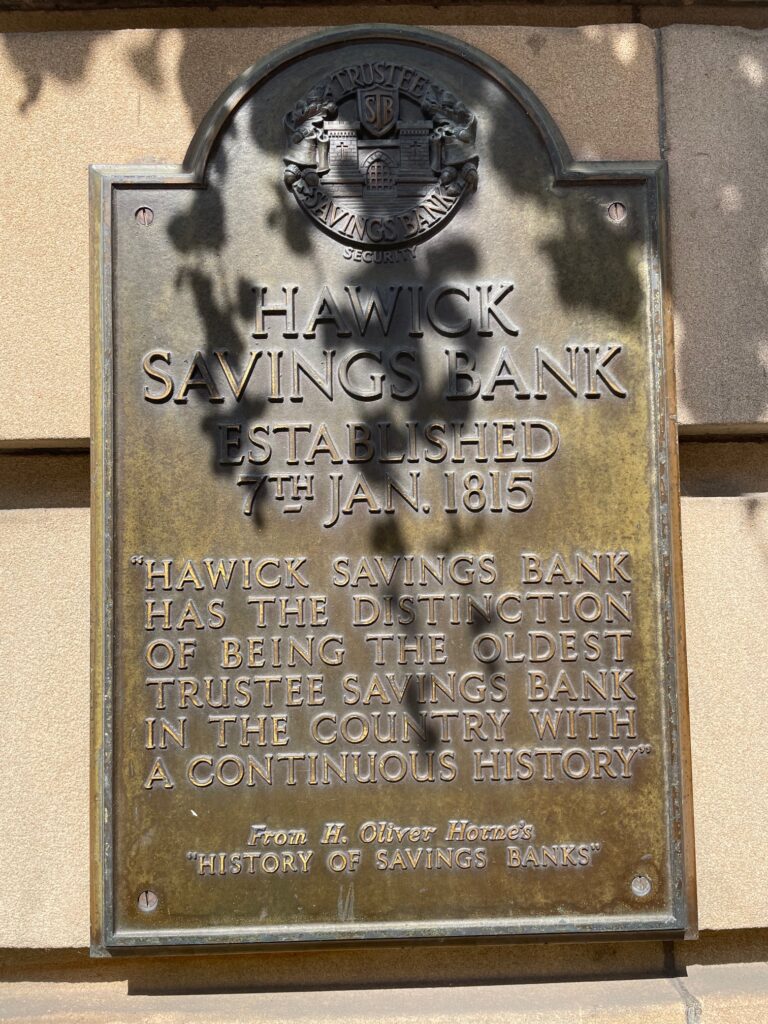
Founded in 1815, Hawick Savings Bank was a trustee savings bank, not a growth institution.

Its purpose was capital preservation, not expansion. In towns with cyclical income and narrow margins, security mattered more than yield. Savings banks formalised thrift, deferred consumption, and custodial trust.

The language carved into stone — trustee, security, continuity — reflects a financial culture focused on endurance rather than leverage.

Production created surplus. Surplus required safekeeping. Safekeeping required trust.


Physical Cash and Risk Management

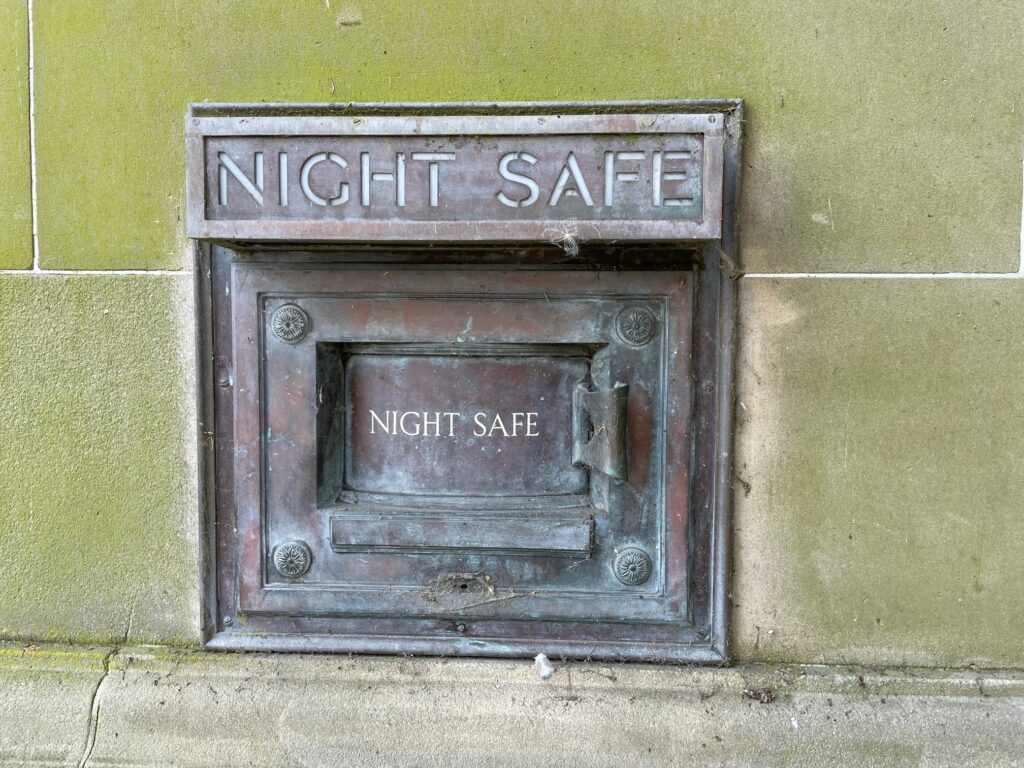
The night safe illustrates how money once moved.

Before electronic settlement, cash accumulation was a daily operational risk. Businesses deposited takings after hours. Banks collected later. Risk was managed mechanically.

Design prioritised security over convenience. Money was earned, counted, deposited, and reconciled. Responsibility was explicit.


Automation and Declining Permanence

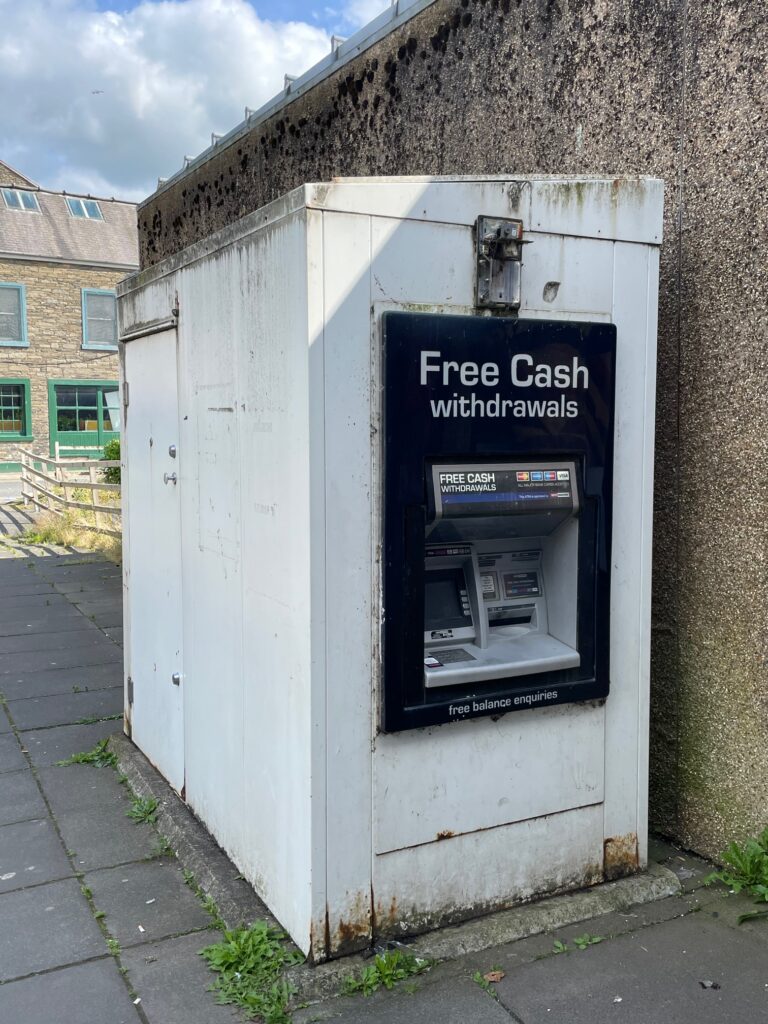
The ATM hut reflects a later phase: access replacing custody.

Banking shifted from deposit to withdrawal, from relationship to convenience, from institutions to machines. This infrastructure expanded rapidly — and is now quietly retreating.

The hut remains not because it is valued, but because removal costs exceed benefit. It was never designed for permanence.


From Local Production to Imperial Circulation

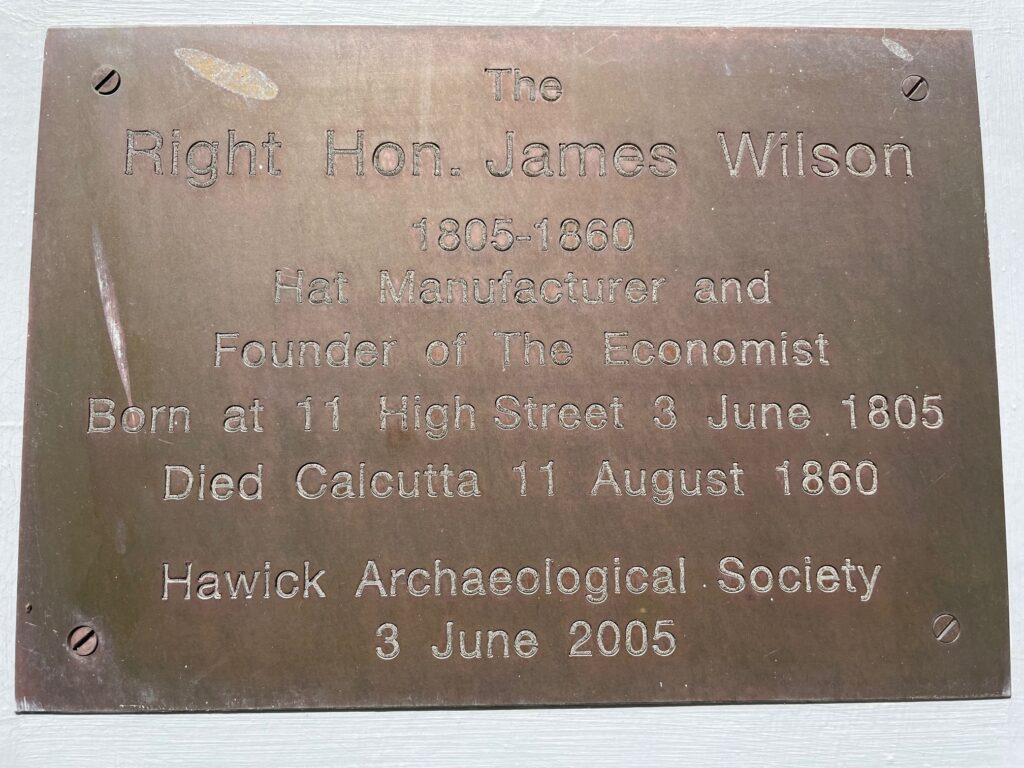
James Wilson, born in Hawick and later active in Calcutta, exemplifies nineteenth-century British economic expansion.

Manufacturing surplus drove wider markets. Those markets required stable currency, predictable rules, and financial commentary. Calcutta was a financial hub of imperial trade.

Hawick was not peripheral to empire. It contributed to it.


Clubs as Economic Infrastructure

Former Conservative Club – now a Wetherspoons

Political and commercial clubs functioned as working institutions. Trade, shipping, currency, and risk were discussed practically.

Empire was not ideological. It was operational.


Border Economies and Mobility

The Borders were historically unstable economic zones. Authority was weak, agriculture marginal, and mobility essential.

The Border Reivers were an adaptive response to pressure. When systems failed to sustain life, people reorganised or moved.

This pattern recurs across economic history.


Population Loss as Signal

Hawick’s population decline was gradual but decisive. Over time, opportunity narrowed relative to other locations.

This was economic sorting. People leave when reward structures weaken. The process is incremental and quiet.

Depopulation follows capital out.


Closing

Hawick demonstrates a basic relationship modern planning often misreads.

Money once followed production. Savings followed discipline. Movement followed pressure. When those links weakened, adaptation followed.

There is periodic discussion of restoring a rail link to Edinburgh. Such a connection would likely bring commuters and property demand. It would not restore locally anchored production.

A commuter economy changes function, not purpose.

The buildings remain.
The systems do not.
What survives is evidence.


Epilogue: Hard Money and Capital Anchors

Hawick’s most successful period coincided with a hard-money regime.

Under hard money, capital allocation was constrained. Credit followed production because it had to. Expansion required output, settlement discipline, and balance. Towns that produced attracted capital. Towns that did not, did not grow.

Hawick met those conditions. Manufacturing anchored trade. Savings accumulated slowly. Banking focused on custody rather than promotion.

The shift to soft money changed the equation.

Once currency became elastic and credit centralised, capital no longer required local production to justify movement. Scale, abstraction, and financial gravity replaced output as the primary attractors. Small industrial towns were not dismantled; they were bypassed.

Infrastructure withdrawal, banking contraction, and population loss followed.

Hard money rewarded Hawick because it produced.
Soft money ignored it because it no longer needed to.

That distinction matters.

As monetary systems again strain under debt, expansion, and declining trust, interest in tangible anchors inevitably returns: production, commodities, settlement reality.

Hawick does not offer a model to recreate.
It offers a reference point for what worked — and under what monetary conditions.

Hard money enforced reality.
Soft money suspended it.

The outcome is visible.

The State as Demon — and Why It Is Always of the People

It is tempting to describe the modern state as evil, predatory, or malicious.
That framing is emotionally satisfying — and analytically weak.

A more accurate description is this:

The state is demonic by function, not by intent.

A demon, in the classical sense, is not a creature with hatred or love. It is a non-human entity that feeds on energy, attention, fear, obedience, and ritual. It grows when invoked, weakens when ignored, and punishes those who attempt to leave its domain.

Modern states behave in exactly this way.

They do not love.
They do not forgive.
They do not remember sacrifice.
They do not respond to truth.

They respond only to inputs.

Once this is understood, the emotional confusion dissolves. The state is not bad in the human sense — it is structurally inhuman.


Denmark: The Cleanest Expression of the Model

Denmark matters because it is not extreme.

It is stable. Orderly. High-trust. Digitised. Efficient.
It represents the idealised endpoint of the contemporary Western project.

And that is precisely why it reveals the underlying mechanics so clearly.

In Denmark, the state has achieved:

  • near-total digital legibility
  • moralised redistribution
  • procedural compassion
  • low tolerance for exit
  • symbolic replacement of traditional authority

This is not tyranny.
It is consensus crystallised into code.


Skattefar and the Abstraction of Fatherhood

Denmark’s most revealing concept is linguistic:

SkattefarTax Father.

Skattefar is a symbolic father.
He provides without presence, authority without relationship, care without obligation.

He can:

  • collect
  • redistribute
  • compel
  • audit
  • punish

He cannot:

  • sit with you at 3am when life collapses
  • quietly fix something at 11pm so it works the next morning
  • absorb emotional chaos without paperwork
  • take responsibility without leverage
  • love without enforcement

Skattefar does not carry.
He processes.

This distinction is not sentimental — it is structural. Real provision is relational, asymmetric, and often invisible. Systems cannot perform it, only simulate it.


borger.dk: How Emotion Becomes Enforcement

The genius — and danger — of the modern welfare state lies in translation.

Through interfaces such as borger.dk, Denmark converts:

  • emotional distress → procedural claim
  • procedural claim → moral legitimacy
  • moral legitimacy → enforced transfer

At no point does anyone need malicious intent.
At no point does anyone need to lie.

The system simply routes pressure to the cheapest available counterparty.

Very often, that counterparty is not the state.

It is a man.


When Skattefar Appears Generous

The welfare state is widely perceived as benevolent because it dispenses resources.

But Skattefar rarely generates those resources.

He reallocates them — often from real far: the biological, relational, economically productive father — through compulsory transfers, maintenance regimes, and moralised redistribution.

The sleight of hand is elegant:

  • the state claims moral credit
  • the man provides the capital
  • the recipient experiences “support”
  • the architecture remains unquestioned

Provision is outsourced.
Authority is retained.


Why Men Are Sidelined — but Never Released

In Denmark’s model society:

  • men are rhetorically unnecessary
  • structurally replaceable
  • emotionally non-essential

Yet they remain:

  • economically critical
  • legally enforceable
  • fiscally visible

This is not a contradiction.
It is the equilibrium.

The modern welfare state cannot fully replace men — but it can displace them from authority while retaining access to their output.


The Cost of Abstracting Responsibility

When care is proceduralised:

  • responsibility becomes enforceable but not reciprocal
  • support becomes rights-based rather than relational
  • failure becomes administrative rather than human

This produces not resilience, but fragility masked as security.

Because when systems fail — and they always do — they fail procedurally, not personally.

Skattefar will not sit with you when the rules stop working.


Why the State Is a Demon — and Why It Is of the People

Calling the state demonic is not moral condemnation.
It is functional description.

But demons are not born.
They are summoned.

A population that is fearful, risk-averse, conflict-avoidant, and responsibility-shifting will inevitably generate a system that promises safety in exchange for visibility, obedience, and dependence.

Denmark did not become Denmark by accident.

It became Denmark because that is what the median Dane psychologically prefers.

The state is not imposed on the people.
It condenses out of them.


Why Walking Away Beats Fighting

The critical mistake men make is believing systems like this can be argued with, rebalanced, or morally corrected.

They cannot.

These systems do not respond to truth, endurance, or sacrifice — only to incentives and exits. Fighting supplies energy, legitimacy, and additional surface area for enforcement. Walking away withdraws the very inputs the system depends on: proximity, compliance, and extractable output.

Distance collapses leverage.
Silence starves escalation.

Exit is not rebellion.
It is realism.

Men do not need to overthrow Skattefar.
They simply need to stop confusing him with a father — and build lives that no longer require his permission.


Further Reading: Nomadic Sovereign

This analysis sits within a broader philosophy of quiet exit — reducing exposure to systems that require dependence while offering diminishing returns.

Nomadic Sovereign explores:

  • mobility over entrenchment
  • sovereignty over permission
  • exit over reform
  • optionality over optimisation

It is not about rebellion or ideology.
It is about seeing systems clearly — and stepping aside from them without drama.

👉 https://nomadicsovereign.com

Pressure on the Reserve

Something shifted quietly tonight.

Gold printed a new all-time high — not with noise, not with headlines, but the way structurally important moves often occur: almost unnoticed.

At the same time, the US dollar weakened sharply. Down close to 3% against sterling in a single week. That is not background volatility for a reserve currency; it is pressure.

Oil, notably absent from the broader commodities move for months, finally joined in — lifting from the low-50s into the 60s in short order. This matters less for the price itself than for what it represents: a late participant acknowledging the same signal others have already acted on.

None of this, taken in isolation, proves anything. Together, they suggest a change in posture.


The Masking Effect

One detail matters here and is easy to miss.

The dollar’s decline, as represented by the DXY basket, is partially masked by another currency deteriorating even faster: the Japanese yen.

Relative weakness hides absolute weakness.

When one major currency is falling more rapidly than another, the slower decline can appear stable by comparison. That optical effect does not indicate strength; it indicates sequencing.

In other words, the dollar does not look weaker than it is — it looks less weak than the yen. Those are not the same thing.


Safe Haven Reconsidered

For decades, the dollar has been the reflexive safe haven — the place capital runs to when uncertainty rises.

What appears to be happening now, even if temporarily, is different.

Capital is stepping sideways.
Not panicking.
Not fleeing indiscriminately.
Simply declining to treat the dollar as the unquestioned anchor.

That distinction matters.

This does not mean collapse is guaranteed.
It does not mean hyperinflation is inevitable.
History does not repeat mechanically.

But there is a historical pattern worth naming.


A Familiar Early Shape

In the early stages of monetary decline — including the Weimar period — the defining feature was not chaos, but disbelief.

Prices moved before narratives did.
Confidence ebbed before institutions acknowledged it.
Currencies were repriced quietly by markets long before they failed publicly.

What we are seeing now fits the early shape of that pattern, not the end stage.

Gold is not rising because of fear.
It is rising because it requires no explanation.

Oil is not rising because of speculation.
It is rising because currency weakness eventually expresses itself in real goods.

The dollar is not collapsing.
It is being questioned.


Doctrine, Not Advice

I would not choose to hold excessive amounts of either the US dollar or the Japanese yen at this moment.

That is not a recommendation.
It is not advice.
It is a personal doctrine based on observed structure.

Doctrines can change.
Signals can reverse.
But doctrine is formed before consensus, not after it.


The Only Point That Matters

For the first time in a long while, the global market is behaving as if the US dollar is one option among many, not the default answer.

That may last weeks.
It may reverse.
It may accelerate.

No timeline is implied.

But the signal is clear enough to state plainly:

When reserve currencies come under pressure, waiting for official confirmation is the most expensive mistake available.

Markets speak before institutions do.
They always have.

And this time, they are speaking quietly — but together.

When the Numbers Finally Moved

I first bought gold in 2005.

Not because I was afraid.
Not because I expected collapse.
But because something felt wrong with how money was explained — and how easily those explanations changed.

Back then, gold was unfashionable.
A relic.
A footnote.

Owning it felt slightly eccentric, like carrying a compass in an age that insisted roads were permanent.

I kept it anyway.


Over the years, I followed the rules.

I worked.
I planned.
I trusted institutions that asked for patience and promised reciprocity.
I believed that if you stayed reasonable, systems would meet you halfway.

Sometimes they did.
Often they didn’t.

What failed wasn’t effort.
It was assumption.

Gold never argued with those assumptions.
It just waited.


I didn’t write much here in 2025.

Not because nothing was happening —
but because this was never meant to be a running commentary.

A watched pot never boils.

If you stare at prices, you miss structure.
If you narrate every move, you lose the arc.

So I stayed quiet.

And while I did, something old and familiar continued doing what it has always done.


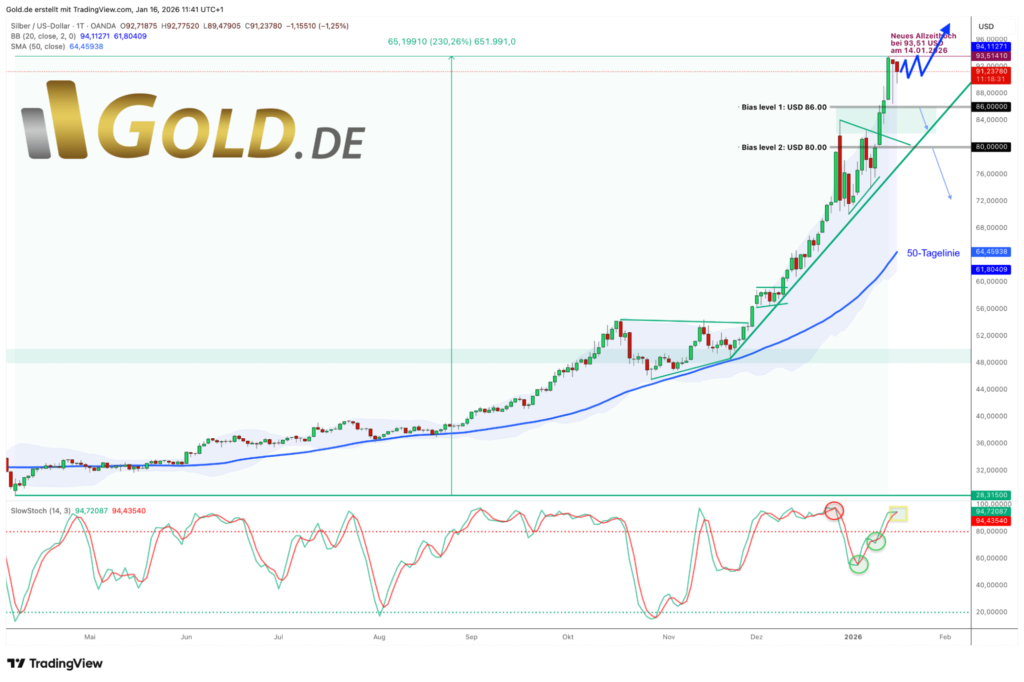
Then came today.

Silver crossed a line it had never crossed before.
Gold pressed against a number that would once have sounded absurd.
Platinum followed.
The miners stirred, late, as they always do.

The graph tells the story better than commentary ever could.

Not a spike.
Not panic.
Continuation.


Because this wasn’t a shock.

It was a catch-up.

Gold didn’t suddenly become valuable.
Silver didn’t suddenly matter.
They simply reached levels that matched a world that had been quietly changing for years.

Debt grew louder.
Trust grew thinner.
Promises multiplied faster than substance.

And through all of it, the metals didn’t negotiate.

They just stayed honest.


People will ask what happens next.

They always do.

But that question misunderstands the point.

This was never about a destination.
It was about orientation.

Gold isn’t a bet on disaster.
Silver isn’t a gamble on chaos.

They are references —
ways of knowing where you are when maps start being redrawn.

That’s what I learned, slowly, starting in 2005.

Not in theory.
In practice.


I didn’t become interested in gold because I wanted to leave the world.

I became interested in gold because I wanted to understand it
and eventually, to move through it without needing permission.

Today’s numbers matter.
But not for the reason most people think.

They matter because they tell you how long this has been underway.

And because, once you see that, you stop waiting for the pot to boil.

You read the currents.

And you keep rowing.

A Watched Pot Never Boils

I didn’t write here in 2025.

Not because nothing was happening —
but because the important things rarely announce themselves.

Markets reward attention.
Value rewards patience.


Gold rose.
Silver followed.
Platinum surprised.
The miners finally stirred.

Anyone watching a screen could see that.

But what matters isn’t what moved —
it’s what didn’t break.


Gold did what it always does.
It held its ground while currencies spoke too much.

Silver moved quickly, as it does when pressure builds.
It never explains itself.
It only reacts.

Platinum returned to relevance without asking permission.

The miners rose, late and uneven, still dependent on the same channels that failed them before.

Nothing snapped.
Nothing resolved.

That is how real change begins.


A watched pot never boils because boiling is the wrong image.

Systems don’t explode.
They thin.

Confidence drains.
Claims multiply.
Paper grows louder as substance grows scarce.

By the time the pot boils, the meal is already ruined.


2025 wasn’t a warning year.
It was a confirmation year.

Those who needed excitement saw prices.
Those who understood structure saw something else entirely:
continuity.

Gold didn’t prove anything.
Silver didn’t announce a future.
They simply stayed honest while everything around them negotiated.


I don’t write to mark every move.

I write to mark the ones that matter.

And the quiet years —
the years when nothing dramatic happens —
are often the ones that decide everything.

Some men wait for storms to prove the sea is dangerous.
Others learn to read the currents and keep rowing.

Schlobitten

I’ve always been extremely interested in World War 2 and the Eastern front, or Ostfronten as the Germans called it. Especially sad to me is the loss of German East Prussia, Pomerania and Silesia, along with the massive deaths, displacement and destruction wreaked during that final year of the war, 1945 and the further destruction that took place after. Much of which is barely covered in history books and seems destined to be lost to time forever soon.

One story in particular sticks in my mind, by Alexander Fürst zu Dohna-Schlobitten, who wrote his memoir of living in one such East Prussian castle upto 1945., Schlobitten. I’ve never personally visited the ruins that exist today, but he builds a picture of happiness, contentment and the general continuation of a life that had existed for hundreds, perhaps a thousand years or more, right up until the day he hears the sound of artillery fire from the east and concludes, rightly, that it may be time to go. He orders the house to be packed, the staff to prepare for exit and so begins the march West to escape. Turning briefly with sadness to face his childhood home and that of his ancestors before saying a silent and final goodbye.

The reason I write this is because this is how it rather feels regarding life in Europe generally. The front line has moved West since 1945 and it isn’t artillery that one physically hears in 2024, but a closing of digital prison walls. Walls and bars heralding the death of freedom, personal responsibility and basic rights such as owning your own productivity, bodily autonomy and being able to say what you think or feel about certain subjects.

In another time, we could’ve sat in our centrally heated homes comfortably, but fate has chosen that we must either face the enemy or flee and like Alexander there, in Schlobitten, with resigned sadness I really don’t see that it’s possible to face the enemy and win.

I choose freedom. After all, “He who runs away, lives to fight another day”, right?

Now, you may be wondering where the Gold or Silver connection is. There isn’t one, although I am sure Alexander had financially prepared for this eventuality by placing savings well outside of the crisis and was probably also carrying a supply of gold and silver coins for any eventualities, this post is all about the freedom part of the trio. Perhaps freedom is the most important of all?

The Four Horsemen of the Apocalypse

It completely missed my attention, and would have remained so had I not reinstalled Instagram on my mobile (#BlueTweedJacket), that the seals are now opened and the four horsemen of the apocalypse have, quite possibly, been released. Bear with me.

It all leads back to a very strange story that occurred on 24/04/2024 in the City of London, when 4 military horses were seemingly startled by some kind of building noise in Belgravia (Gematria : “Rise of the Phoenix”, remember this Economist cover from 1988?

“behold, a pale horse and his name that sat upon him was death..”

You can read about the horses here and work out the imagery for yourself. The key part for me is how the four horses ran through the City of London, much to the amazement of onlookers. Thus it was announced. I wonder if the names Vida, Trojan, Quaker and Tennyson could be signs in some way too?

For the uninitiated, the City of London is a separate country within the UK, explaining the bizarre yearly ceremony where the Monarch has to ask permission from the Lord Mayor of London to enter the City of London. I am unsure if fakey Prince Charley has done it yet, perhaps the City would say no, knowing he’s not really King. Seemingly, anyway, this all happened as the result of magically generating the finance for royalty to win their wars and the power of the City grew, to the extent that Corporations inside the city have votes, like citizens do, not that are many left within the old Roman city walls. A population decline that began with a Great Fire, way back in 1666. Oh wait a sec, 24/04/2024 (2+4)(4+2)(2+4)…666 again? After clearing the lower-grade humans away from inside the city, it went on to gain prominence in controlling world finance and the world of corpus-rations, or dead entities. You could even argue it controls the USA through the Eurodollar market, allowing it to manage and use the world reserve currency for it’s own purposes, exactly as it did with the British Pound, prior to 1926.

I can see the pieces linking together, Winston Churchill, as Chancellor of the Exchequer back in 1926 unrelentingly demanded a strong pound after the inflationary costs of The Great War, causing a general strike and leaving many coal miners without income and starving (I sense my own ancestors suffered too), which thanks the Lords of Finance book, explains how this led to a trans-Atlantic trade of Gold flowing across to the USA after WW1 and ultimately left the USA atop the world in 1945. Compare that to the closely-comparable current flow of gold from Europe and North America to Asia, or the new Switzerland of the East, Singapore. Got to wonder why he did it, eh? Or maybe, got to wonder who he did it for.

Match that with “You will own nothing and be happy” mantra of the World Economic Forum. Many of us are meant to die, especially the unproductive ones (by their measurements, let’s just ignore that not everything that can be counted, counts) and those that survive are meant to have every part of their lives tracked and controlled. I’m not joking, Denmark already has 95% of the population signed up to a Digital ID that includes a contract clause for allowing the bank, local government, any government agency (think : the health dept says you didn´t get the latest booster of the COVID-25 vaccine) and anyone else to basically lock your ID. No paying for anything, no access to anything, no state healthcare, no car, no nothing. If you don’t believe me that it’s already weaponised, ask this guy here, who without yet being convicted of any crime took part in a trucker protest by lobbing some potatoes on the motorway and got locked out.

Now, what about the names of those horses? Well, the first one, it maps via Gematria to “Dollar Collapse”, then the next one is called Trojan. Aha, another clue perhaps? What is Gold still measured in, even today? The city people once thought was a myth, somehow managed to have a weight named after it, the Troy ounce, used to measure gold. The one solid money unit people have always known they can rely on when everything else falls apart. Any ideas on those two other names…? Well, Tennyson was a Victorian poet whose most famous poem line was “Theirs not to reason why, theirs but to do and die.“, about the Charge of The Light Brigade in the Crimean war, and I seem to recall something happening in Crimea right now again. Quaker, a religion or an Earthquake. It may become clearer later.

I think I see the financial future clearer now. When money dies, as it has just been anounced it will, then we all turn back to gold, even briefly as the one unit we can trust, then the system resets, just as it did in 1923 for Germany (and 1945-46, again, painfully) and how it always works out for every fiat currency that has ever existed, be it Pounds, Francs, Dollars, Livres, Pengo or Dollars. Those that don’t prepare at all, be it by holding gold, silver or even tinned food are destined to expire, or fight, in a Darwinian trial that the elite will enjoy watching unfold and are poised, ready to grab your assets on the cheap. Then they’ll offer you the solution to scarce expensive food, rationing implemented and managed via an app on your phone. Digital ID worldwide through the back door and their Central Bank Digital Currency (CBDC), with all the controls they wanted all along.

Gold in the 1970s: A Decade of Unprecedented Performance

The 1970s marked a pivotal decade for gold, characterized by extreme volatility and exceptional gains. This period was defined by a series of economic events that dramatically influenced the global financial landscape. Here, we explore how gold performed during the 1970s and the official explanations for its behavior.

The End of the Bretton Woods System

The decade began with a critical shift in the global financial system: the end of the Bretton Woods Agreement in 1971. Established post-World War II, the Bretton Woods system had fixed exchange rates with the US dollar pegged to gold at $35 per ounce. However, due to mounting inflationary pressures and excessive US dollar printing to fund government spending (notably the Vietnam War), President Richard Nixon announced the suspension of the dollar’s convertibility into gold. This decision effectively ended the Bretton Woods system and led to the free-floating of currency exchange rates. The uncertainty and resultant instability in the forex markets drove investors towards gold as a safe haven asset.

Inflation and Economic Uncertainty

The 1970s were marked by high inflation, triggered by several factors including the oil crises of 1973 and 1979. The OPEC oil embargo led to skyrocketing oil prices and severe inflation across economies, severely eroding the purchasing power of fiat currencies. Gold, traditionally viewed as a hedge against inflation, saw increased demand. As consumer prices rose, so did the allure of gold as a store of value.

Investment Demand

With the collapse of the fixed currency exchange system and rising inflation, investors increasingly turned to gold. The decade also saw the legalization of gold ownership for US citizens in 1974, further boosting demand. Prior to this, gold ownership had been restricted to certificates and limited forms of bullion. The legislative change allowed private ownership of gold bars and coins, increasing the accessibility of gold to the general public and sparking a surge in investment demand.

Global Political Instability

The 1970s were rife with geopolitical tensions and conflicts, including the continuation of the Cold War, the Vietnam War, and various Middle Eastern conflicts following the oil crisis. Such events added to the economic uncertainty and boosted gold’s role as a crisis commodity.

Performance Recap

The cumulative effect of these factors was profound. Gold prices skyrocketed from $35 per ounce at the beginning of the decade to approximately $850 per ounce by January 1980. This represented an extraordinary gain, reflecting gold’s status as a safe haven during times of economic turmoil.

Conclusion

The 1970s established gold as a powerhouse investment, influenced by a complex interplay of economic policies, market dynamics, and geopolitical tensions. The decade not only underscored gold’s crucial role in the financial system as a hedge against inflation and currency devaluation but also marked its resurgence as a key asset in investment portfolios worldwide.

This summary provides a concise overview of the major drivers behind gold’s performance in the 1970s, illustrating how it became a cornerstone asset for investors seeking stability in turbulent times.

Assessing Gold Performance in the December-January Period

Introduction:

Gold has long been considered a safe-haven asset, and its investment performance is closely scrutinized, especially during volatile periods. The months of December and January often bring about a unique set of circumstances that can impact the precious metal’s value. In this article, we will explore the historical performance of gold investments during the typical December-January period and analyze the factors that contribute to its fluctuations.

Historical Trends:

  1. Year-End Demand: Historically, the demand for gold tends to rise towards the end of the year. Investors often seek to diversify their portfolios and hedge against economic uncertainties, making gold an attractive option. This increased demand can contribute to upward pressure on prices.
  2. Festive Season and Jewelry Demand: The holiday season, particularly in December, sees a surge in consumer spending and, consequently, an uptick in the demand for gold jewelry. This spike in demand can influence the overall performance of gold during this period.
  3. Market Volatility: The transition from one calendar year to the next often brings about increased market volatility. Uncertainties related to economic data, geopolitical events, and global tensions can drive investors towards safe-haven assets like gold.
  4. Dollar Performance: The performance of the U.S. dollar can have a significant impact on gold prices. When the dollar weakens, gold becomes more attractive to investors as it is priced in dollars. Conversely, a stronger dollar may put downward pressure on gold prices.
  5. Interest Rates: Central bank policies and interest rate decisions also play a crucial role in determining gold prices. Generally, lower interest rates make non-interest-bearing assets like gold more appealing, while higher rates may have the opposite effect.

Case Studies:

Let’s delve into a few notable instances to highlight gold’s performance during December and January in recent years.

  1. 2019-2020: The end of 2019 and the beginning of 2020 saw heightened global uncertainties, including trade tensions and geopolitical issues. During this period, gold prices experienced a significant rally as investors sought safety amid market turbulence.
  2. 2020-2021: The COVID-19 pandemic heavily influenced financial markets in 2020. Gold, acting as a safe-haven asset, witnessed robust demand during the peak of the crisis. As economies started recovering in 2021, gold prices faced some downward pressure.
  3. 2021-2022: The transition from 2021 to 2022 was marked by concerns about inflation, central bank policies, and ongoing pandemic-related challenges. Gold prices exhibited volatility, responding to changing economic conditions and global uncertainties.

Conclusion:

While historical trends suggest that gold tends to perform well during the December-January period, it’s essential for investors to consider a broader set of factors that can influence its value. Economic indicators, geopolitical events, and changes in market sentiment all contribute to the intricate dance of gold prices.

As with any investment, thorough research and a clear understanding of the global economic landscape are crucial. While gold may offer stability during times of uncertainty, prudent investors should diversify their portfolios and stay informed about the dynamic factors affecting the precious metal’s performance.

« Older posts

© 2026 InvestGold

Theme by Anders NorénUp ↑