Author: Dunwiddie

Five Investor Failings — And How to Tackle Them Head On

There are many ways to lose money in markets. Bad ideas. Bad luck. Bad timing. Fraud. Leverage. Dilution. Macro shocks.

But most serious private investors eventually discover a more uncomfortable truth: the biggest damage often comes not from ignorance, but from self-sabotage after being right.

That is the stage no one romanticises. The trade works. The market pays you. Your confidence rises. Your position grows. The story gets stronger. You begin to think you are being rewarded for insight when in fact you are being tested on discipline.

That is where the real game begins.

Below are five investor failings that do the most damage once a person has already become reasonably competent — and the direct ways to tackle them.

1. Falling in love with the story

This is the oldest trap in the book.

You find something early. It is misunderstood, hated, or ignored. You buy it when others will not. It works. You feel vindicated. The investment stops being an allocation and starts becoming proof of who you are.

Now you are no longer holding a position. You are defending an identity.

That is when discipline weakens. You stop asking, “What role should this play in the portfolio?” and start asking, “How can I justify keeping it?” Story replaces structure. Narrative replaces sizing. Loyalty replaces judgment.

The market loves this phase because it knows exactly what you are now: sticky.

How to tackle it head on

Separate the thesis from the vehicle.

You may be right on gold, but wrong on the size of your miner exposure.
You may be right on energy, but wrong to let one oil stock dominate the book.
You may be right on innovation, but wrong to let one special situation become sacred.

The stronger the story, the stricter the rule set should be. Not looser. Stricter.

A good line to keep in mind is this:

The more a holding flatters your self-image, the less discretion you should allow yourself over its size.

2. Letting winners outrun their mandate

This is where many profitable investors quietly give back huge sums.

A position starts as a trade, a dislocation, or a tactical sleeve. It rises strongly. You feel clever. The gain reinforces your trust in it. Without making an explicit decision, you allow it to become something larger than it was ever meant to be.

This is how a tactical position acquires core privileges.

It is also how a good idea becomes a future regret.

The problem is not usually entry. The problem is that success creates emotional exemption. The holding is now “special.” You let it run past the size it was supposed to occupy. Then the first serious pullback becomes psychologically intolerable because the position is no longer properly sized for its true role.

How to tackle it head on

Hard caps.

Not vague intentions. Not “I’ll review it later.” Hard caps.

For example:

  • no individual investment trust above 10%
  • no individual ETF above 5%
  • approach to cap means a trim plan goes live
  • breach of cap means action, not reflection

That changes the game. You no longer ask whether a winner deserves to keep growing. You ask whether it still fits the architecture.

The key principle is simple:

Performance does not overrule portfolio law.

In fact, strong performance is when portfolio law matters most.

3. Confusing discount with permission

Investment trust investors are especially vulnerable to this one.

A trust sits on a wide discount. That feels like protection. You tell yourself it is still cheap, still below NAV, still misunderstood, still due for recognition. All of this may be true.

And still completely irrelevant.

Because discount is not risk control. Discount is part of valuation. That is not the same thing.

A trust can be on a 25% or 30% discount and still be the wrong size, the wrong wrapper, or the wrong psychological burden for the rest of the portfolio. A large discount does not magically convert bad position sizing into good governance.

Many investors use discount the way drunks use philosophy: to justify what they already want to do.

How to tackle it head on

Put your hierarchy in the right order:

  1. Size
  2. Role
  3. Wrapper
  4. Valuation / discount

That means:

  • if the position is too big, reduce it
  • if it is in the wrong account, question it
  • if it is non-core, stop giving it core tolerance
  • only then does the discount get to speak

A good permanent rule is:

No discount is big enough to justify a holding being above its allowed size.

That one sentence can save a lot of money.

4. Making major decisions in a bad state

This one is under-discussed because investors like to imagine they are disembodied rational minds.

They are not.

Sleep matters. Alcohol matters. Sexual frustration matters. Stress matters. Travel disruption matters. Personal loss matters. Humiliation matters. They all feed into execution.

A person can have the right portfolio rule and still implement it disastrously because they are operating in a flooded state. Then later they tell themselves the market tricked them, when the truth is simpler: they acted while biologically compromised.

This is not softness. It is operating reality.

Good portfolio management is partly about valuation. It is also partly about state control.

How to tackle it head on

Build a state filter into your investment process.

No major trims, exits, or reallocations when you are:

  • badly sleep-deprived
  • angry
  • sexually overcharged and unfocused
  • drinking
  • humiliated by recent moves
  • desperate for relief

In that state, you can plan. You can write the target. You can define the trim. But you do not execute size changes in thin or volatile instruments.

The rule is:

If I am highly charged, I may analyse — but I do not execute.

That is not weakness. That is edge protection.

5. Treating every asset like it is forever

This may be the deepest failing of all.

Many investors unconsciously apply a loyalty model where an allocation model is required.

They buy. They hold. They ignore noise. They call this conviction. Then they watch a position start to dominate mood, bandwidth, and decision quality. The asset becomes something they have to carry. It clouds their thinking. Yet they still cling to the idea that this is somehow noble.

It is not noble. It is often lazy.

Not everything is meant to be held forever. Some positions are there to be ridden, harvested, and replaced. Some are there to be accumulated, celebrated, then exited. Some are there to be rebuilt later from lower levels. Some are core. Many are not.

If you do not know the difference, everything eventually becomes a liability.

How to tackle it head on

For every holding, define:

  • why it exists
  • what bucket it belongs to
  • how large it is allowed to become
  • what would cause you to add
  • what would cause you to trim
  • what would cause you to leave

That means you stop thinking in terms of loyalty and start thinking in terms of role.

The most powerful shift an investor can make is this:

Holdings are not relationships. They are allocations.

Once that clicks, many things become easier:

  • trimming strength
  • selling partials
  • rebuilding later
  • reducing overlap
  • refusing duplication
  • keeping cash without shame

The deeper pattern

These five failings are linked.

Falling in love with the story leads to letting winners outrun their mandate.
Letting winners outrun their mandate leads to discount logic being used as a sedative.
Discount logic leads to delayed action.
Delayed action, combined with bad personal state, leads to ugly execution.
Ugly execution then creates self-disgust, which tempts the investor to either overtrade or swear off discipline entirely.

That cycle is what has to be broken.

The answer is not to become cold in some inhuman way. The answer is to become more deliberate.

Better architecture. Better caps. Better state control. Better separation between core and tactical. Better understanding of when cash is not failure but optionality.

Why this matters more than stock picking

Private investors love to focus on ideas. Which trust. Which ETF. Which commodity. Which country. Which sector.

But once a certain level of competence is reached, stock picking is rarely the main differentiator. The bigger difference comes from whether the investor can:

  • keep sizing aligned with role
  • harvest when the market is flattering them
  • avoid acting in a bad state
  • and stop one successful idea from hijacking the entire machine

That is where returns are kept or lost.

Final thought

The real transition in investing is not from bad ideas to good ideas.

It is from attachment to allocation.

You can still have conviction.
You can still back hated assets.
You can still ride big themes.
You can still accumulate patiently.

But the position must never become larger than the portfolio’s ability to govern it.

That is the line.

And once you learn it, really learn it, markets become less like a source of emotional weather and more like what they actually are:

A field of temporary opportunities to be entered, sized, harvested, and left behind when their job is done.

A Coin from the Edge of the Sea

Saturday, the coast again.
No plan beyond walking, listening to the detector, letting the ground decide what—if anything—it wanted to give up.

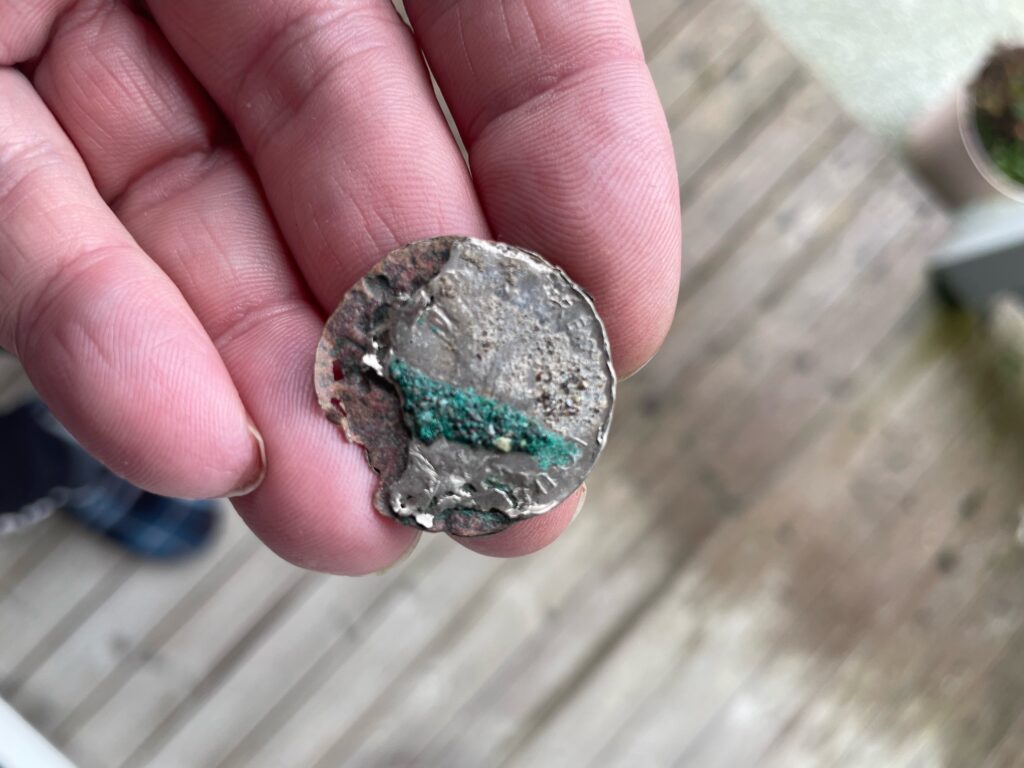
What came out of the sand didn’t look like a coin at first. Just a bent disc, flaking, scarred, almost tired. The kind of object most people would drop back where they found it.

But weight tells its own story.

Once cleaned enough to see structure rather than detail, the deception became obvious. A skin of silver, thin and failing, lifting away to reveal a copper core beneath. The green line—verdigris—cutting through it like a confession finally made under pressure.

This wasn’t damage.
It was design.

A forged silver coin. Almost certainly French. Georgian era. Made not to last, but to pass. Made to move quickly from hand to hand before anyone stopped to test it too closely.

Someone, two centuries ago, held this same object and decided it was “good enough”.

Money on the Move

Coins like this didn’t belong to collectors or kings. They lived in markets, taverns, ports. They moved with sailors, traders, soldiers—people in transit. People who valued speed over certainty.

Silver coinage worked because trust worked. Weight, colour, sound. That was enough. Most of the time.

Clipping the edges, plating copper, reducing fineness—these weren’t anomalies. They were symptoms. Wherever money moves, someone tries to make it lighter without anyone noticing.

This coin survived because it succeeded. For a while.

Eventually it failed, as they all do. The sea finished the audit that merchants once performed by hand.

Found, Not Explained

I don’t know whose pocket this sat in.
I don’t know what it bought, or when it was finally rejected.

What I do know is that it travelled. It crossed hands, borders, and probably arguments. It outlived the person who made it, and the person who passed it on.

Now it sits on a table, silver peeling away, copper exposed, the disguise no longer worth maintaining.

A small object, carried forward by chance, turning up exactly where journeys tend to end—at the edge of the water.

I put it aside with the others.
Not as a lesson.
Just as evidence that the road has always been like this.

I found it where journeys pause—at the waterline, where disguises no longer matter.

Hawick: A Case Study in Capital, Money, and Decline

Hawick provides a clear case study of how a small industrial town once integrated into Britain’s productive and financial system — and what remains after that integration dissolves.

This was not a peripheral settlement. Hawick was deliberately built and connected because it produced. Its Georgian and Victorian architecture reflects capital deployed with confidence: mills, commercial streets, banks, clubs, and river infrastructure designed to serve output rather than appearance.

The town’s economic logic remains visible. Even after industrial contraction, the structure of production, finance, and circulation can still be read in stone and layout.

Hawick was once a mainline railway stop, linking Scotland through England to London. Such connectivity followed volume and output, not policy ambition. The railway’s removal was not the cause of decline but confirmation of it. As production diminished and capital withdrew, infrastructure followed.

Infrastructure does not fail first. It responds to capital flow.


Scottish Banknotes and Residual Issuing Power

Scotland remains one of the few developed economies where private commercial banks issue circulating currency.

These notes are denominated in sterling and fully backed by Bank of England reserves, but the issuing authority remains with individual banks. This is a surviving feature of an earlier monetary system in which money issuance was tied to trade-embedded institutions rather than centralised state monopoly.

The arrangement reflects a period when money followed reputation, settlement discipline, and local credibility. The notes are not symbolic. They are operational remnants of a decentralised monetary structure.


Savings Banks and Capital Preservation

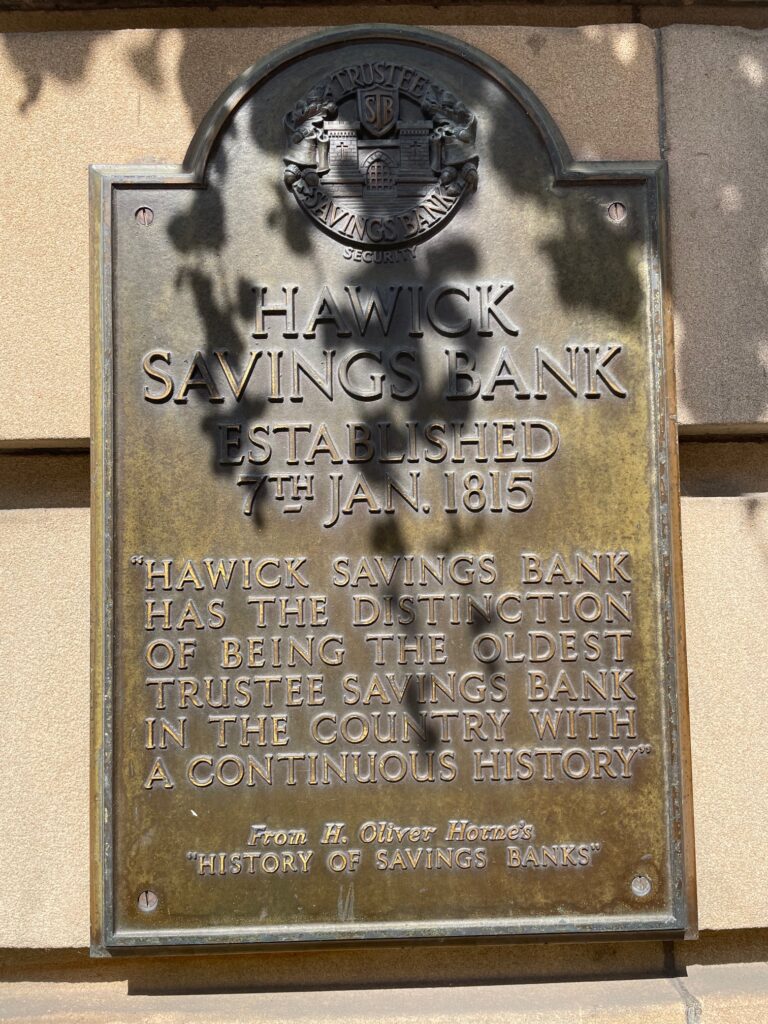
Founded in 1815, Hawick Savings Bank was a trustee savings bank, not a growth institution.

Its purpose was capital preservation, not expansion. In towns with cyclical income and narrow margins, security mattered more than yield. Savings banks formalised thrift, deferred consumption, and custodial trust.

The language carved into stone — trustee, security, continuity — reflects a financial culture focused on endurance rather than leverage.

Production created surplus. Surplus required safekeeping. Safekeeping required trust.


Physical Cash and Risk Management

The night safe illustrates how money once moved.

Before electronic settlement, cash accumulation was a daily operational risk. Businesses deposited takings after hours. Banks collected later. Risk was managed mechanically.

Design prioritised security over convenience. Money was earned, counted, deposited, and reconciled. Responsibility was explicit.


Automation and Declining Permanence

The ATM hut reflects a later phase: access replacing custody.

Banking shifted from deposit to withdrawal, from relationship to convenience, from institutions to machines. This infrastructure expanded rapidly — and is now quietly retreating.

The hut remains not because it is valued, but because removal costs exceed benefit. It was never designed for permanence.


From Local Production to Imperial Circulation

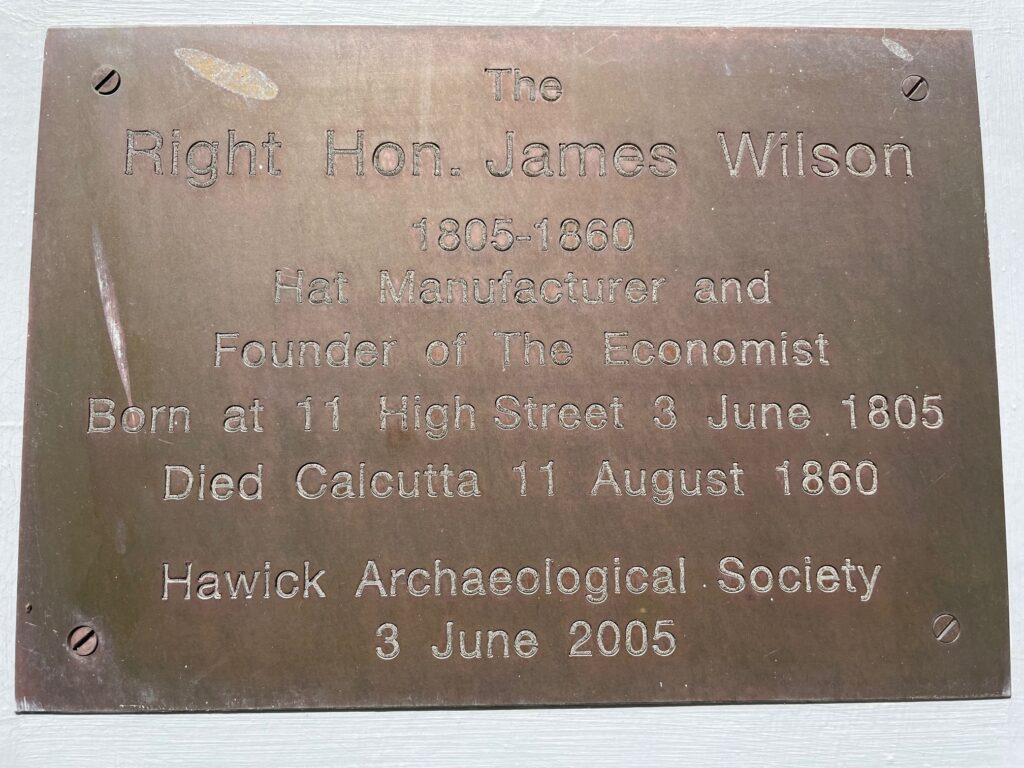
James Wilson, born in Hawick and later active in Calcutta, exemplifies nineteenth-century British economic expansion.

Manufacturing surplus drove wider markets. Those markets required stable currency, predictable rules, and financial commentary. Calcutta was a financial hub of imperial trade.

Hawick was not peripheral to empire. It contributed to it.


Clubs as Economic Infrastructure

Former Conservative Club – now a Wetherspoons

Political and commercial clubs functioned as working institutions. Trade, shipping, currency, and risk were discussed practically.

Empire was not ideological. It was operational.


Border Economies and Mobility

The Borders were historically unstable economic zones. Authority was weak, agriculture marginal, and mobility essential.

The Border Reivers were an adaptive response to pressure. When systems failed to sustain life, people reorganised or moved.

This pattern recurs across economic history.


Population Loss as Signal

Hawick’s population decline was gradual but decisive. Over time, opportunity narrowed relative to other locations.

This was economic sorting. People leave when reward structures weaken. The process is incremental and quiet.

Depopulation follows capital out.


Closing

Hawick demonstrates a basic relationship modern planning often misreads.

Money once followed production. Savings followed discipline. Movement followed pressure. When those links weakened, adaptation followed.

There is periodic discussion of restoring a rail link to Edinburgh. Such a connection would likely bring commuters and property demand. It would not restore locally anchored production.

A commuter economy changes function, not purpose.

The buildings remain.
The systems do not.
What survives is evidence.


Epilogue: Hard Money and Capital Anchors

Hawick’s most successful period coincided with a hard-money regime.

Under hard money, capital allocation was constrained. Credit followed production because it had to. Expansion required output, settlement discipline, and balance. Towns that produced attracted capital. Towns that did not, did not grow.

Hawick met those conditions. Manufacturing anchored trade. Savings accumulated slowly. Banking focused on custody rather than promotion.

The shift to soft money changed the equation.

Once currency became elastic and credit centralised, capital no longer required local production to justify movement. Scale, abstraction, and financial gravity replaced output as the primary attractors. Small industrial towns were not dismantled; they were bypassed.

Infrastructure withdrawal, banking contraction, and population loss followed.

Hard money rewarded Hawick because it produced.
Soft money ignored it because it no longer needed to.

That distinction matters.

As monetary systems again strain under debt, expansion, and declining trust, interest in tangible anchors inevitably returns: production, commodities, settlement reality.

Hawick does not offer a model to recreate.
It offers a reference point for what worked — and under what monetary conditions.

Hard money enforced reality.
Soft money suspended it.

The outcome is visible.

The State as Demon — and Why It Is Always of the People

It is tempting to describe the modern state as evil, predatory, or malicious.
That framing is emotionally satisfying — and analytically weak.

A more accurate description is this:

The state is demonic by function, not by intent.

A demon, in the classical sense, is not a creature with hatred or love. It is a non-human entity that feeds on energy, attention, fear, obedience, and ritual. It grows when invoked, weakens when ignored, and punishes those who attempt to leave its domain.

Modern states behave in exactly this way.

They do not love.
They do not forgive.
They do not remember sacrifice.
They do not respond to truth.

They respond only to inputs.

Once this is understood, the emotional confusion dissolves. The state is not bad in the human sense — it is structurally inhuman.


Denmark: The Cleanest Expression of the Model

Denmark matters because it is not extreme.

It is stable. Orderly. High-trust. Digitised. Efficient.
It represents the idealised endpoint of the contemporary Western project.

And that is precisely why it reveals the underlying mechanics so clearly.

In Denmark, the state has achieved:

  • near-total digital legibility
  • moralised redistribution
  • procedural compassion
  • low tolerance for exit
  • symbolic replacement of traditional authority

This is not tyranny.
It is consensus crystallised into code.


Skattefar and the Abstraction of Fatherhood

Denmark’s most revealing concept is linguistic:

SkattefarTax Father.

Skattefar is a symbolic father.
He provides without presence, authority without relationship, care without obligation.

He can:

  • collect
  • redistribute
  • compel
  • audit
  • punish

He cannot:

  • sit with you at 3am when life collapses
  • quietly fix something at 11pm so it works the next morning
  • absorb emotional chaos without paperwork
  • take responsibility without leverage
  • love without enforcement

Skattefar does not carry.
He processes.

This distinction is not sentimental — it is structural. Real provision is relational, asymmetric, and often invisible. Systems cannot perform it, only simulate it.


borger.dk: How Emotion Becomes Enforcement

The genius — and danger — of the modern welfare state lies in translation.

Through interfaces such as borger.dk, Denmark converts:

  • emotional distress → procedural claim
  • procedural claim → moral legitimacy
  • moral legitimacy → enforced transfer

At no point does anyone need malicious intent.
At no point does anyone need to lie.

The system simply routes pressure to the cheapest available counterparty.

Very often, that counterparty is not the state.

It is a man.


When Skattefar Appears Generous

The welfare state is widely perceived as benevolent because it dispenses resources.

But Skattefar rarely generates those resources.

He reallocates them — often from real far: the biological, relational, economically productive father — through compulsory transfers, maintenance regimes, and moralised redistribution.

The sleight of hand is elegant:

  • the state claims moral credit
  • the man provides the capital
  • the recipient experiences “support”
  • the architecture remains unquestioned

Provision is outsourced.
Authority is retained.


Why Men Are Sidelined — but Never Released

In Denmark’s model society:

  • men are rhetorically unnecessary
  • structurally replaceable
  • emotionally non-essential

Yet they remain:

  • economically critical
  • legally enforceable
  • fiscally visible

This is not a contradiction.
It is the equilibrium.

The modern welfare state cannot fully replace men — but it can displace them from authority while retaining access to their output.


The Cost of Abstracting Responsibility

When care is proceduralised:

  • responsibility becomes enforceable but not reciprocal
  • support becomes rights-based rather than relational
  • failure becomes administrative rather than human

This produces not resilience, but fragility masked as security.

Because when systems fail — and they always do — they fail procedurally, not personally.

Skattefar will not sit with you when the rules stop working.


Why the State Is a Demon — and Why It Is of the People

Calling the state demonic is not moral condemnation.
It is functional description.

But demons are not born.
They are summoned.

A population that is fearful, risk-averse, conflict-avoidant, and responsibility-shifting will inevitably generate a system that promises safety in exchange for visibility, obedience, and dependence.

Denmark did not become Denmark by accident.

It became Denmark because that is what the median Dane psychologically prefers.

The state is not imposed on the people.
It condenses out of them.


Why Walking Away Beats Fighting

The critical mistake men make is believing systems like this can be argued with, rebalanced, or morally corrected.

They cannot.

These systems do not respond to truth, endurance, or sacrifice — only to incentives and exits. Fighting supplies energy, legitimacy, and additional surface area for enforcement. Walking away withdraws the very inputs the system depends on: proximity, compliance, and extractable output.

Distance collapses leverage.
Silence starves escalation.

Exit is not rebellion.
It is realism.

Men do not need to overthrow Skattefar.
They simply need to stop confusing him with a father — and build lives that no longer require his permission.


Further Reading: Nomadic Sovereign

This analysis sits within a broader philosophy of quiet exit — reducing exposure to systems that require dependence while offering diminishing returns.

Nomadic Sovereign explores:

  • mobility over entrenchment
  • sovereignty over permission
  • exit over reform
  • optionality over optimisation

It is not about rebellion or ideology.
It is about seeing systems clearly — and stepping aside from them without drama.

👉 https://nomadicsovereign.com

Pressure on the Reserve

Something shifted quietly tonight.

Gold printed a new all-time high — not with noise, not with headlines, but the way structurally important moves often occur: almost unnoticed.

At the same time, the US dollar weakened sharply. Down close to 3% against sterling in a single week. That is not background volatility for a reserve currency; it is pressure.

Oil, notably absent from the broader commodities move for months, finally joined in — lifting from the low-50s into the 60s in short order. This matters less for the price itself than for what it represents: a late participant acknowledging the same signal others have already acted on.

None of this, taken in isolation, proves anything. Together, they suggest a change in posture.


The Masking Effect

One detail matters here and is easy to miss.

The dollar’s decline, as represented by the DXY basket, is partially masked by another currency deteriorating even faster: the Japanese yen.

Relative weakness hides absolute weakness.

When one major currency is falling more rapidly than another, the slower decline can appear stable by comparison. That optical effect does not indicate strength; it indicates sequencing.

In other words, the dollar does not look weaker than it is — it looks less weak than the yen. Those are not the same thing.


Safe Haven Reconsidered

For decades, the dollar has been the reflexive safe haven — the place capital runs to when uncertainty rises.

What appears to be happening now, even if temporarily, is different.

Capital is stepping sideways.
Not panicking.
Not fleeing indiscriminately.
Simply declining to treat the dollar as the unquestioned anchor.

That distinction matters.

This does not mean collapse is guaranteed.
It does not mean hyperinflation is inevitable.
History does not repeat mechanically.

But there is a historical pattern worth naming.


A Familiar Early Shape

In the early stages of monetary decline — including the Weimar period — the defining feature was not chaos, but disbelief.

Prices moved before narratives did.
Confidence ebbed before institutions acknowledged it.
Currencies were repriced quietly by markets long before they failed publicly.

What we are seeing now fits the early shape of that pattern, not the end stage.

Gold is not rising because of fear.
It is rising because it requires no explanation.

Oil is not rising because of speculation.
It is rising because currency weakness eventually expresses itself in real goods.

The dollar is not collapsing.
It is being questioned.


Doctrine, Not Advice

I would not choose to hold excessive amounts of either the US dollar or the Japanese yen at this moment.

That is not a recommendation.
It is not advice.
It is a personal doctrine based on observed structure.

Doctrines can change.
Signals can reverse.
But doctrine is formed before consensus, not after it.


The Only Point That Matters

For the first time in a long while, the global market is behaving as if the US dollar is one option among many, not the default answer.

That may last weeks.
It may reverse.
It may accelerate.

No timeline is implied.

But the signal is clear enough to state plainly:

When reserve currencies come under pressure, waiting for official confirmation is the most expensive mistake available.

Markets speak before institutions do.
They always have.

And this time, they are speaking quietly — but together.

When the Numbers Finally Moved

I first bought gold in 2005.

Not because I was afraid.
Not because I expected collapse.
But because something felt wrong with how money was explained — and how easily those explanations changed.

Back then, gold was unfashionable.
A relic.
A footnote.

Owning it felt slightly eccentric, like carrying a compass in an age that insisted roads were permanent.

I kept it anyway.


Over the years, I followed the rules.

I worked.
I planned.
I trusted institutions that asked for patience and promised reciprocity.
I believed that if you stayed reasonable, systems would meet you halfway.

Sometimes they did.
Often they didn’t.

What failed wasn’t effort.
It was assumption.

Gold never argued with those assumptions.
It just waited.


I didn’t write much here in 2025.

Not because nothing was happening —
but because this was never meant to be a running commentary.

A watched pot never boils.

If you stare at prices, you miss structure.
If you narrate every move, you lose the arc.

So I stayed quiet.

And while I did, something old and familiar continued doing what it has always done.


Then came today.

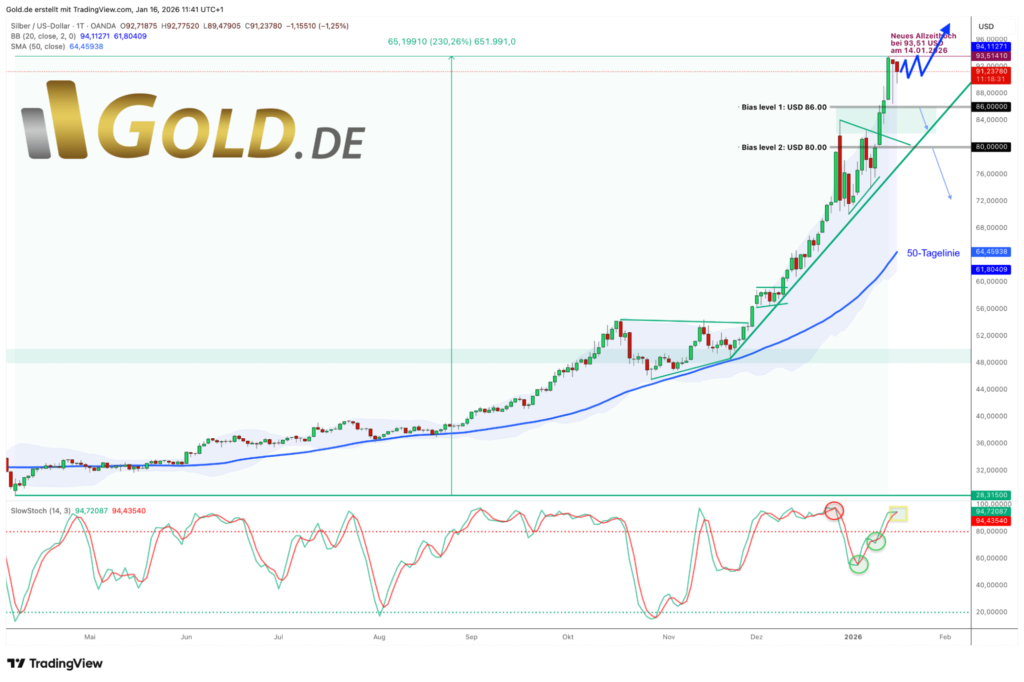
Silver crossed a line it had never crossed before.
Gold pressed against a number that would once have sounded absurd.
Platinum followed.
The miners stirred, late, as they always do.

The graph tells the story better than commentary ever could.

Not a spike.
Not panic.
Continuation.


Because this wasn’t a shock.

It was a catch-up.

Gold didn’t suddenly become valuable.
Silver didn’t suddenly matter.
They simply reached levels that matched a world that had been quietly changing for years.

Debt grew louder.
Trust grew thinner.
Promises multiplied faster than substance.

And through all of it, the metals didn’t negotiate.

They just stayed honest.


People will ask what happens next.

They always do.

But that question misunderstands the point.

This was never about a destination.
It was about orientation.

Gold isn’t a bet on disaster.
Silver isn’t a gamble on chaos.

They are references —
ways of knowing where you are when maps start being redrawn.

That’s what I learned, slowly, starting in 2005.

Not in theory.
In practice.


I didn’t become interested in gold because I wanted to leave the world.

I became interested in gold because I wanted to understand it
and eventually, to move through it without needing permission.

Today’s numbers matter.
But not for the reason most people think.

They matter because they tell you how long this has been underway.

And because, once you see that, you stop waiting for the pot to boil.

You read the currents.

And you keep rowing.

A Watched Pot Never Boils

I didn’t write here in 2025.

Not because nothing was happening —
but because the important things rarely announce themselves.

Markets reward attention.
Value rewards patience.


Gold rose.
Silver followed.
Platinum surprised.
The miners finally stirred.

Anyone watching a screen could see that.

But what matters isn’t what moved —
it’s what didn’t break.


Gold did what it always does.
It held its ground while currencies spoke too much.

Silver moved quickly, as it does when pressure builds.
It never explains itself.
It only reacts.

Platinum returned to relevance without asking permission.

The miners rose, late and uneven, still dependent on the same channels that failed them before.

Nothing snapped.
Nothing resolved.

That is how real change begins.


A watched pot never boils because boiling is the wrong image.

Systems don’t explode.
They thin.

Confidence drains.
Claims multiply.
Paper grows louder as substance grows scarce.

By the time the pot boils, the meal is already ruined.


2025 wasn’t a warning year.
It was a confirmation year.

Those who needed excitement saw prices.
Those who understood structure saw something else entirely:
continuity.

Gold didn’t prove anything.
Silver didn’t announce a future.
They simply stayed honest while everything around them negotiated.


I don’t write to mark every move.

I write to mark the ones that matter.

And the quiet years —
the years when nothing dramatic happens —
are often the ones that decide everything.

Some men wait for storms to prove the sea is dangerous.
Others learn to read the currents and keep rowing.

© 2026 InvestGold

Theme by Anders NorénUp ↑