Category: History of Money (Page 1 of 4)

The Receipt in the Silver Book

Dunwiddie did not trust objects that arrived with too much explanation.

A dealer’s label, a certificate, a story written in careful ink — these things often served the same function as a salesman’s smile. They did not prove value. They covered the places where value might be missing.

He preferred things found in poor light.

A coin under black sand. A book in a damp box. A tarnished spoon in a mixed lot. The old thing that had not been arranged for admiration.

That morning he went to the car boot sale.

He had not planned to buy anything. That was always the first lie.

The field was wet, and the sellers had laid their lives out on folding tables: china dogs, golf clubs, cracked lamps, DVDs, brass candlesticks, toy cars, fishing reels, old biscuit tins, watches that had stopped at unimportant times. Ireland looked especially honest when it was selling its cupboards in a field.

At the far end, beside a van with a missing hubcap, an elderly man had three boxes of books.

Dunwiddie stopped.

Books were dangerous.

Not because they cost money. Because they cost rooms. A book entered a man’s life modestly, then multiplied into shelves, boxes, weight, sentiment, and the accusation of unread pages.

Still, he looked.

The first box was rubbish. Celebrity memoirs, thrillers, cookbooks with photographs of food no one had cooked since 1998.

The second was better. Local history. Railway pamphlets. A book on Wicklow churches. A battered volume on coinage.

The third box contained an old silver book.

Not actual silver. Grey cloth, faded at the edges, with a title stamped in dull letters:

The Story of Money

He picked it up.

The seller watched him.

“Nice old thing, that.”

Dunwiddie disliked that sentence immediately.

“How much?”

“Five.”

He opened the book. No dust jacket. Foxed pages. Underlining in pencil. A name on the flyleaf.

Edward L. Mason, 1963.

A respectable name. A dead name, almost certainly. The kind of name that had once written cheques, received bank statements, owned a good coat.

Dunwiddie turned a few pages.

There were chapters on barter, coinage, paper money, banking, inflation, gold, trust. The usual route. Civilisation explained as a series of improved promises, most of them eventually broken.

“Three,” he said.

The old man shrugged.

“Go on.”

Dunwiddie paid and put the book in his bag.

On the way home, he stopped for coffee. The place was half-full. Two builders, a woman with a child, a man in a navy fleece reading racing results, and three retired women speaking loudly about someone who had gone into hospital and ought to have known better.

He placed the book on the table and opened it again.

It had the smell he liked: dust, paper, old houses, the faint sweet rot of stored knowledge.

He read a passage about the debasement of coinage.

The author wrote in the solemn tone of a man who still believed institutions could be embarrassed by their own failures.

Dunwiddie smiled.

Then something fell from between the pages.

A receipt.

Small. Folded. Yellowed.

He picked it up carefully.

It was not a shop receipt. It was a bank slip.

Midland Bank.

Date: 17 October 1971.

Amount: £400.

Deposited by: E. L. Mason.

He held it for a moment.

£400 in 1971 was not nothing. Not fortune, but substance. A good month’s pay for many men. Several months for some. Enough to matter.

On the back, in the same neat hand as the flyleaf, someone had written:

For when paper fails.

That interested him.

He turned the receipt over again.

A bank deposit slip hidden inside a book about money, marked as protection against paper itself. That was either wit, confusion, or a man trying to leave himself a warning.

Dunwiddie liked all three possibilities.

He finished his coffee and took the book home.

At the room, he put it on the table beside his coin trays. Outside, the sky had cleared slightly. The sea could not be seen, but he sensed it there: a large moving accountant beyond the houses, forever settling the shoreline.

He opened the book properly now.

The receipt had come from chapter six: The Gold Standard and Its Enemies.

That amused him.

He read for an hour. The book was not brilliant, but it had a certain old-world confidence. It believed money was a moral technology. That men who clipped coins, printed too much paper, or broke convertibility had not merely made policy choices but committed a kind of spiritual fraud.

Dunwiddie understood the attraction of that view.

He also distrusted it.

Men who moralised money often failed to notice the better question: who has optionality when the promise breaks?

Late afternoon, he inspected the bank slip again.

£400.

For when paper fails.

He looked up the date in memory.

Nixon had closed the gold window that August.

Two months later, Edward L. Mason had deposited £400 in Midland Bank and written that sentence on the back of the slip.

Perhaps Mason had misunderstood everything.

Perhaps he believed the bank deposit itself was safety.

Or perhaps the slip recorded the opposite: £400 withdrawn, converted, hidden, transformed into something that did not need permission.

The wording was ambiguous.

Deposited by.

Not withdrawn.

But old bank paperwork could deceive. Or he could be reading desire into evidence. A familiar risk.

He turned more pages.

Another slip fell out.

This one was not yellowed in the same way. It was thicker. Folded twice.

He opened it.

A pawnbroker’s receipt.

Birmingham.

Same date.

17 October 1971.

One item received: Gold sovereigns x 22.

Customer: E. L. Mason.

Amount paid: £400.

Dunwiddie sat back.

There it was.

The bank slip had not been the refuge.

It had been the decoy.

Mason had taken paper from the bank and turned it into sovereigns.

Then he had hidden the evidence in a book about money, behind a chapter on gold, with a sentence dry enough to survive fifty years:

For when paper fails.

Dunwiddie laughed.

Not loudly. Respectfully.

The old boy had not been confused. He had been precise.

But there was more.

The pawnbroker’s receipt had writing on the back too.

A different hand. Smaller. Later.

Sold by Mother, March 1981. Needed for the roof.

That changed the room.

He placed both slips on the table.

There was the whole human monetary cycle in two scraps of paper.

A man sees the failure of paper and buys gold.

A family inherits the gold and sells it for shelter.

The sovereigns survive as metal, but not as possession.

The roof survives a little longer.

The book survives because no one values it enough to sell.

And fifty years later, another man buys it for three euro in a wet field and receives the only part of the fortune that could still speak: the record of the decision.

He sat with that for a while.

It was a better lesson than finding the coins would have been.

If the sovereigns had still been there, the story would have become simple. Treasure. Luck. Profit. A man buys a book and finds gold. Cheap magic.

But the absence was superior.

The gold had done its work.

That was the twist.

People spoke of gold as if its highest purpose were to remain untouched forever, glowing uselessly in a vault while men congratulated themselves on discipline. But Mason’s sovereigns had not failed because they were sold.

They had succeeded.

They crossed ten years of broken money and reappeared as a roof over someone’s head.

That was not liquidation.

That was fulfilment.

Dunwiddie looked at his own shelves, his coins, his funds, his carefully separated accounts, his maps of jurisdiction and exit. He understood then why the story pleased him so much.

Wealth was not what a man kept.

Wealth was what still had agency when the weather changed.

He put the two receipts back into the book, but not where he had found them. He placed them at the front, behind Edward L. Mason’s name.

Then he took a pencil and wrote underneath:

He understood the crossing.

He closed the book.

The grey cover gave nothing away.

That was right.

The best things rarely did.
A Coin from the Edge of the Sea

Saturday, the coast again.
No plan beyond walking, listening to the detector, letting the ground decide what—if anything—it wanted to give up.

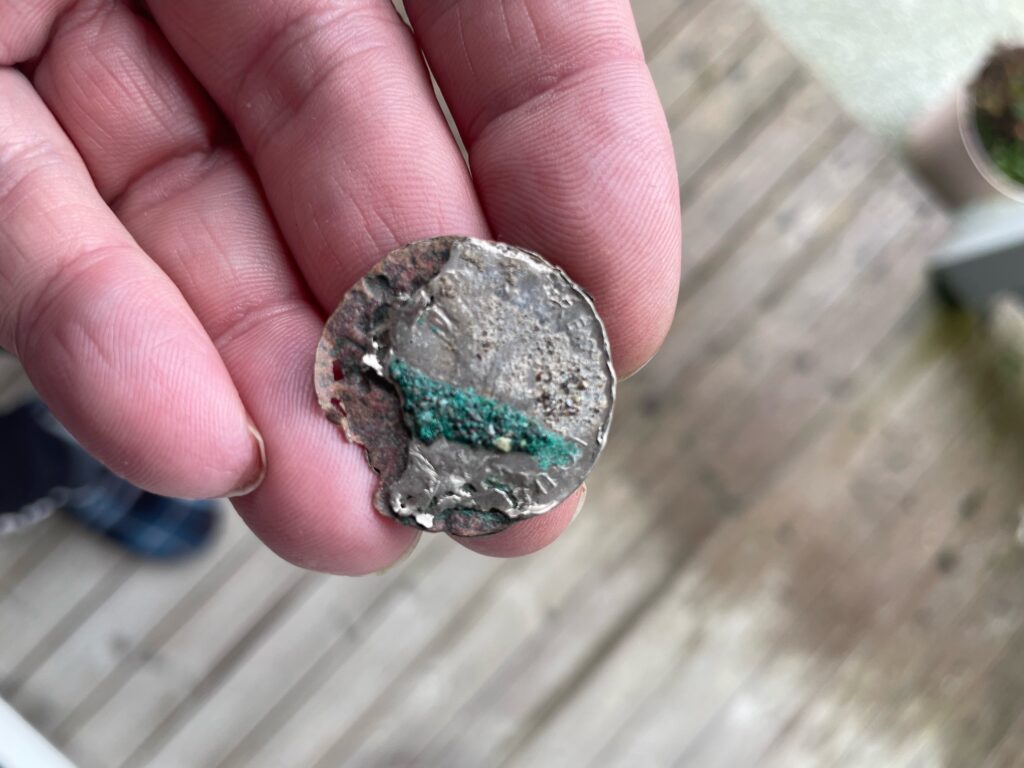
What came out of the sand didn’t look like a coin at first. Just a bent disc, flaking, scarred, almost tired. The kind of object most people would drop back where they found it.

But weight tells its own story.

Once cleaned enough to see structure rather than detail, the deception became obvious. A skin of silver, thin and failing, lifting away to reveal a copper core beneath. The green line—verdigris—cutting through it like a confession finally made under pressure.

This wasn’t damage.
It was design.

A forged silver coin. Almost certainly French. Georgian era. Made not to last, but to pass. Made to move quickly from hand to hand before anyone stopped to test it too closely.

Someone, two centuries ago, held this same object and decided it was “good enough”.

Money on the Move

Coins like this didn’t belong to collectors or kings. They lived in markets, taverns, ports. They moved with sailors, traders, soldiers—people in transit. People who valued speed over certainty.

Silver coinage worked because trust worked. Weight, colour, sound. That was enough. Most of the time.

Clipping the edges, plating copper, reducing fineness—these weren’t anomalies. They were symptoms. Wherever money moves, someone tries to make it lighter without anyone noticing.

This coin survived because it succeeded. For a while.

Eventually it failed, as they all do. The sea finished the audit that merchants once performed by hand.

Found, Not Explained

I don’t know whose pocket this sat in.
I don’t know what it bought, or when it was finally rejected.

What I do know is that it travelled. It crossed hands, borders, and probably arguments. It outlived the person who made it, and the person who passed it on.

Now it sits on a table, silver peeling away, copper exposed, the disguise no longer worth maintaining.

A small object, carried forward by chance, turning up exactly where journeys tend to end—at the edge of the water.

I put it aside with the others.
Not as a lesson.
Just as evidence that the road has always been like this.

I found it where journeys pause—at the waterline, where disguises no longer matter.

The Four Horsemen of the Apocalypse

It completely missed my attention, and would have remained so had I not reinstalled Instagram on my mobile (#BlueTweedJacket), that the seals are now opened and the four horsemen of the apocalypse have, quite possibly, been released. Bear with me.

It all leads back to a very strange story that occurred on 24/04/2024 in the City of London, when 4 military horses were seemingly startled by some kind of building noise in Belgravia (Gematria : “Rise of the Phoenix”, remember this Economist cover from 1988?

“behold, a pale horse and his name that sat upon him was death..”

You can read about the horses here and work out the imagery for yourself. The key part for me is how the four horses ran through the City of London, much to the amazement of onlookers. Thus it was announced. I wonder if the names Vida, Trojan, Quaker and Tennyson could be signs in some way too?

For the uninitiated, the City of London is a separate country within the UK, explaining the bizarre yearly ceremony where the Monarch has to ask permission from the Lord Mayor of London to enter the City of London. I am unsure if fakey Prince Charley has done it yet, perhaps the City would say no, knowing he’s not really King. Seemingly, anyway, this all happened as the result of magically generating the finance for royalty to win their wars and the power of the City grew, to the extent that Corporations inside the city have votes, like citizens do, not that are many left within the old Roman city walls. A population decline that began with a Great Fire, way back in 1666. Oh wait a sec, 24/04/2024 (2+4)(4+2)(2+4)…666 again? After clearing the lower-grade humans away from inside the city, it went on to gain prominence in controlling world finance and the world of corpus-rations, or dead entities. You could even argue it controls the USA through the Eurodollar market, allowing it to manage and use the world reserve currency for it’s own purposes, exactly as it did with the British Pound, prior to 1926.

I can see the pieces linking together, Winston Churchill, as Chancellor of the Exchequer back in 1926 unrelentingly demanded a strong pound after the inflationary costs of The Great War, causing a general strike and leaving many coal miners without income and starving (I sense my own ancestors suffered too), which thanks the Lords of Finance book, explains how this led to a trans-Atlantic trade of Gold flowing across to the USA after WW1 and ultimately left the USA atop the world in 1945. Compare that to the closely-comparable current flow of gold from Europe and North America to Asia, or the new Switzerland of the East, Singapore. Got to wonder why he did it, eh? Or maybe, got to wonder who he did it for.

Match that with “You will own nothing and be happy” mantra of the World Economic Forum. Many of us are meant to die, especially the unproductive ones (by their measurements, let’s just ignore that not everything that can be counted, counts) and those that survive are meant to have every part of their lives tracked and controlled. I’m not joking, Denmark already has 95% of the population signed up to a Digital ID that includes a contract clause for allowing the bank, local government, any government agency (think : the health dept says you didn´t get the latest booster of the COVID-25 vaccine) and anyone else to basically lock your ID. No paying for anything, no access to anything, no state healthcare, no car, no nothing. If you don’t believe me that it’s already weaponised, ask this guy here, who without yet being convicted of any crime took part in a trucker protest by lobbing some potatoes on the motorway and got locked out.

Now, what about the names of those horses? Well, the first one, it maps via Gematria to “Dollar Collapse”, then the next one is called Trojan. Aha, another clue perhaps? What is Gold still measured in, even today? The city people once thought was a myth, somehow managed to have a weight named after it, the Troy ounce, used to measure gold. The one solid money unit people have always known they can rely on when everything else falls apart. Any ideas on those two other names…? Well, Tennyson was a Victorian poet whose most famous poem line was “Theirs not to reason why, theirs but to do and die.“, about the Charge of The Light Brigade in the Crimean war, and I seem to recall something happening in Crimea right now again. Quaker, a religion or an Earthquake. It may become clearer later.

I think I see the financial future clearer now. When money dies, as it has just been anounced it will, then we all turn back to gold, even briefly as the one unit we can trust, then the system resets, just as it did in 1923 for Germany (and 1945-46, again, painfully) and how it always works out for every fiat currency that has ever existed, be it Pounds, Francs, Dollars, Livres, Pengo or Dollars. Those that don’t prepare at all, be it by holding gold, silver or even tinned food are destined to expire, or fight, in a Darwinian trial that the elite will enjoy watching unfold and are poised, ready to grab your assets on the cheap. Then they’ll offer you the solution to scarce expensive food, rationing implemented and managed via an app on your phone. Digital ID worldwide through the back door and their Central Bank Digital Currency (CBDC), with all the controls they wanted all along.

Gold in the 1970s: A Decade of Unprecedented Performance

The 1970s marked a pivotal decade for gold, characterized by extreme volatility and exceptional gains. This period was defined by a series of economic events that dramatically influenced the global financial landscape. Here, we explore how gold performed during the 1970s and the official explanations for its behavior.

The End of the Bretton Woods System

The decade began with a critical shift in the global financial system: the end of the Bretton Woods Agreement in 1971. Established post-World War II, the Bretton Woods system had fixed exchange rates with the US dollar pegged to gold at $35 per ounce. However, due to mounting inflationary pressures and excessive US dollar printing to fund government spending (notably the Vietnam War), President Richard Nixon announced the suspension of the dollar’s convertibility into gold. This decision effectively ended the Bretton Woods system and led to the free-floating of currency exchange rates. The uncertainty and resultant instability in the forex markets drove investors towards gold as a safe haven asset.

Inflation and Economic Uncertainty

The 1970s were marked by high inflation, triggered by several factors including the oil crises of 1973 and 1979. The OPEC oil embargo led to skyrocketing oil prices and severe inflation across economies, severely eroding the purchasing power of fiat currencies. Gold, traditionally viewed as a hedge against inflation, saw increased demand. As consumer prices rose, so did the allure of gold as a store of value.

Investment Demand

With the collapse of the fixed currency exchange system and rising inflation, investors increasingly turned to gold. The decade also saw the legalization of gold ownership for US citizens in 1974, further boosting demand. Prior to this, gold ownership had been restricted to certificates and limited forms of bullion. The legislative change allowed private ownership of gold bars and coins, increasing the accessibility of gold to the general public and sparking a surge in investment demand.

Global Political Instability

The 1970s were rife with geopolitical tensions and conflicts, including the continuation of the Cold War, the Vietnam War, and various Middle Eastern conflicts following the oil crisis. Such events added to the economic uncertainty and boosted gold’s role as a crisis commodity.

Performance Recap

The cumulative effect of these factors was profound. Gold prices skyrocketed from $35 per ounce at the beginning of the decade to approximately $850 per ounce by January 1980. This represented an extraordinary gain, reflecting gold’s status as a safe haven during times of economic turmoil.

Conclusion

The 1970s established gold as a powerhouse investment, influenced by a complex interplay of economic policies, market dynamics, and geopolitical tensions. The decade not only underscored gold’s crucial role in the financial system as a hedge against inflation and currency devaluation but also marked its resurgence as a key asset in investment portfolios worldwide.

This summary provides a concise overview of the major drivers behind gold’s performance in the 1970s, illustrating how it became a cornerstone asset for investors seeking stability in turbulent times.

Assessing Gold Performance in the December-January Period

Introduction:

Gold has long been considered a safe-haven asset, and its investment performance is closely scrutinized, especially during volatile periods. The months of December and January often bring about a unique set of circumstances that can impact the precious metal’s value. In this article, we will explore the historical performance of gold investments during the typical December-January period and analyze the factors that contribute to its fluctuations.

Historical Trends:

  1. Year-End Demand: Historically, the demand for gold tends to rise towards the end of the year. Investors often seek to diversify their portfolios and hedge against economic uncertainties, making gold an attractive option. This increased demand can contribute to upward pressure on prices.
  2. Festive Season and Jewelry Demand: The holiday season, particularly in December, sees a surge in consumer spending and, consequently, an uptick in the demand for gold jewelry. This spike in demand can influence the overall performance of gold during this period.
  3. Market Volatility: The transition from one calendar year to the next often brings about increased market volatility. Uncertainties related to economic data, geopolitical events, and global tensions can drive investors towards safe-haven assets like gold.
  4. Dollar Performance: The performance of the U.S. dollar can have a significant impact on gold prices. When the dollar weakens, gold becomes more attractive to investors as it is priced in dollars. Conversely, a stronger dollar may put downward pressure on gold prices.
  5. Interest Rates: Central bank policies and interest rate decisions also play a crucial role in determining gold prices. Generally, lower interest rates make non-interest-bearing assets like gold more appealing, while higher rates may have the opposite effect.

Case Studies:

Let’s delve into a few notable instances to highlight gold’s performance during December and January in recent years.

  1. 2019-2020: The end of 2019 and the beginning of 2020 saw heightened global uncertainties, including trade tensions and geopolitical issues. During this period, gold prices experienced a significant rally as investors sought safety amid market turbulence.
  2. 2020-2021: The COVID-19 pandemic heavily influenced financial markets in 2020. Gold, acting as a safe-haven asset, witnessed robust demand during the peak of the crisis. As economies started recovering in 2021, gold prices faced some downward pressure.
  3. 2021-2022: The transition from 2021 to 2022 was marked by concerns about inflation, central bank policies, and ongoing pandemic-related challenges. Gold prices exhibited volatility, responding to changing economic conditions and global uncertainties.

Conclusion:

While historical trends suggest that gold tends to perform well during the December-January period, it’s essential for investors to consider a broader set of factors that can influence its value. Economic indicators, geopolitical events, and changes in market sentiment all contribute to the intricate dance of gold prices.

As with any investment, thorough research and a clear understanding of the global economic landscape are crucial. While gold may offer stability during times of uncertainty, prudent investors should diversify their portfolios and stay informed about the dynamic factors affecting the precious metal’s performance.

Platinum, the Jim Rogers View

Investing in platinum and palladium, according to Jim Rogers, is akin to uncovering hidden treasures in the commodities market—both metals bear unique characteristics and play pivotal roles in industrial applications, presenting intriguing investment opportunities for the astute investor.

Platinum: The Precious Metal with Industrial Might

“Platinum wears the dual crown of luxury and utility,” Rogers might opine. He recognizes platinum’s status as a prestigious precious metal, often associated with high-end jewelry and automotive catalysts. However, he would highlight its critical role in industries like automobile manufacturing, emphasizing its scarcity and indispensability in catalytic converters for cleaner emissions.

Palladium: The Unsung Hero of Industrial Demand

Rogers might describe palladium as the silent workhorse of the metals market. He’d underscore its dominance in the automotive sector, particularly in gasoline-powered vehicle catalysts. “Palladium quietly powers the wheels of the automotive world,” he’d suggest, acknowledging its essential role in reducing harmful emissions.

Supply-Demand Dynamics

Supply-demand fundamentals are crucial to Rogers’ perspective on platinum and palladium. He might delve into the challenges of their production, highlighting the concentration of mining in specific geographic regions like South Africa and Russia. He’d likely emphasize that supply disruptions or geopolitical tensions in these regions can significantly impact prices due to limited global production.

Macro Trends and Price Volatility

Similar to his outlook on other commodities, Rogers might relate platinum and palladium’s price movements to broader economic trends. He’d emphasize their sensitivity to global economic conditions, industrial demand, and geopolitical factors. “Platinum and palladium ride the waves of economic cycles,” he’d note, acknowledging their susceptibility to market volatility.

Physical Metals vs. Mining Equities

Rogers might express a preference for physical ownership of platinum and palladium over investing in mining companies. He’d likely highlight the risks associated with mining stocks, including operational challenges, geopolitical uncertainties, and management decisions. “In these metals, owning the physical assets is akin to holding the crown jewels,” he’d suggest, emphasizing the tangible value of owning the metals themselves.

Long-Term Potential

Jim Rogers’ investment philosophy involves seeking long-term value, and he might view platinum and palladium through a similar lens. He’d likely advocate for these metals as potential hedges against inflation and a part of a diversified investment portfolio, emphasizing their enduring industrial significance and scarcity.

In essence, Jim Rogers’ perspective on platinum and palladium investing underscores their dual nature as precious metals with industrial importance. He sees them as integral components of the commodities market, presenting opportunities for investors who understand their unique dynamics and their roles in both luxury and industrial sectors.

Jim is most reknowned for his 1970s Quantum fund management with George Soros and more lately, his move to Singapore. He seems to have a knack for knowing when to buy low and sell high and freely shares his insights via interviews and Books.

Jim Rogers, Investing Master on Gold

I asked recently what Jim Rogers, the author of such classics as The Investment Biker and Hot Commodities, had to say about Gold. And here it is.

Investing in gold, according to the legendary investor Jim Rogers, isn’t merely a financial move—it’s a testament to understanding the pulse of the global economy and the cyclical nature of markets.

“Gold isn’t just a shiny metal; it’s a beacon of economic insight,” Rogers might emphasize. His approach to gold investing is deeply rooted in history and a profound understanding of market dynamics.

Gold as a Store of Value

Rogers often views gold as a historical store of value, dating back centuries. “Gold has weathered the storms of civilizations,” he’d assert, pointing to its enduring status as a haven asset during times of geopolitical turmoil or economic uncertainty. In his eyes, owning gold isn’t just about profit; it’s a means of preserving wealth across generations.

The Dollar and Gold Relationship

One of Rogers’ fundamental tenets is the inverse relationship between the US dollar and gold. He acknowledges that when the dollar weakens, gold tends to strengthen. “The dollar and gold dance an intricate tango,” he’d remark. For him, this correlation underscores the importance of gold as a hedge against currency devaluation.

The Role of Central Banks

Central banks’ actions significantly influence Rogers’ perspective on gold. He’s been vocal about their impact on the metal’s price through buying and selling, recognizing their position as major players in the gold market. “When central banks sneeze, gold catches a cold,” he might quip, underscoring how their policies can sway gold’s trajectory.

Mining Companies vs. Physical Gold

Rogers might advocate for holding physical gold over investing in gold mining companies. While acknowledging the potential profits in mining stocks during bullish cycles, he often highlights the risks associated with management decisions, operational challenges, and geopolitical uncertainties that impact mining companies. “When investing in miners, you’re not just betting on gold, you’re betting on management,” he’d caution.

A Contrarian View

Rogers’ contrarian nature might also surface in his views on gold. He might advocate for buying gold when sentiment is low and selling when exuberance prevails. “The time to buy is when there’s blood in the streets,” he might quip, emphasizing the importance of taking positions when others are fearful.

Long-Term Perspective

Jim Rogers is known for his long-term investment horizon, and his views on gold align with this philosophy. He might emphasize that gold isn’t a get-rich-quick scheme; rather, it’s a hedge against uncertainty over extended periods. “Think in decades, not days,” he’d advise, highlighting the importance of patience and resilience in gold investing.

Diversification and Gold

For Rogers, gold is a vital component of a diversified portfolio. He wouldn’t advocate going all-in on gold but rather incorporating it as part of a balanced investment strategy. “Diversification is essential in the investment jungle,” he’d opine, advocating for a mix of assets to mitigate risks.

Final Thoughts

In the world of investing, Jim Rogers’ approach to gold is a mosaic of historical perspective, macroeconomic understanding, and a contrarian’s eye for opportunity. To him, gold isn’t just a metal; it’s a reflection of human history, economic cycles, and a prudent safeguard against the unpredictability of financial markets. His words echo a timeless sentiment: “When in doubt, bet on gold.”

Jim is most reknowned for his 1970s Quantum fund management with George Soros and more lately, his move to Singapore. He seems to have a knack for knowing when to buy low and sell high and freely shares his insights via interviews and Books.

The Glittering Prospects of Investing in Gold and Silver Mining ETFs

In a world where financial markets sway like a pendulum, investors perennially seek sturdy and reliable assets to safeguard their wealth. Among the constellation of investment options, gold and silver have stood the test of time, revered for their intrinsic value and as a hedge against market volatility. While purchasing physical bullion has been a traditional avenue, an increasingly popular and diversified approach is investing in Gold and Silver Mining Exchange-Traded Funds (ETFs).

Understanding Gold and Silver Mining ETFs

Gold and Silver Mining ETFs encapsulate a basket of companies involved in the exploration, extraction, and production of these precious metals. Investors gain exposure to multiple mining companies through a single investment vehicle, benefiting from the collective performance of the underlying companies within the ETF.

Advantages of Investing in Gold and Silver Mining ETFs

1. Diversification: These ETFs offer exposure to a diversified portfolio of mining companies, mitigating individual company risk. Fluctuations in any one company’s performance have a diluted impact on the overall investment.

2. Liquidity and Accessibility: Buying and selling ETF shares is relatively easy, offering liquidity compared to investing directly in individual mining companies. Investors can trade ETF shares on major exchanges during market hours.

3. Cost-Efficiency: Gold and Silver Mining ETFs generally have lower expenses compared to actively managed funds. They offer a cost-effective way to gain exposure to the precious metals sector.

4. Risk Mitigation: While individual mining companies can face operational, geopolitical, or financial risks, a diversified ETF spreads risk across multiple companies, potentially reducing the impact of adverse events on the investment.

Disadvantages to Consider

1. Volatility: Precious metal prices, and consequently mining ETFs, can be highly volatile. Fluctuations in commodity prices, global economic conditions, and currency movements can impact the fund’s performance.

2. Company-Specific Risks: Despite diversification, if a significant holding within the ETF faces operational issues or regulatory hurdles, it can affect the overall fund performance.

3. Tracking Error: Some ETFs might not perfectly track the performance of the underlying assets due to factors like fees, expenses, and the fund’s methodology.

Safety Aspects of Holding Shares in an ETF

The safety of holding shares in a Gold and Silver Mining ETF is contingent on various factors:

1. Regulatory Oversight: ETFs are regulated investment products, subject to oversight by financial authorities, ensuring a level of investor protection.

2. Asset Custody: ETFs typically employ reputable custodians to safeguard the underlying assets, reducing the risk of mismanagement or fraud.

3. Transparency: Most ETFs regularly disclose their holdings, allowing investors to monitor the composition of the fund and the performance of underlying assets.

4. Market Liquidity: The ability to easily buy and sell ETF shares on the open market provides a level of liquidity, allowing investors to exit positions without significant price impact.

In Conclusion

Investing in Gold and Silver Mining ETFs can offer an avenue for exposure to precious metals without the complexities of owning physical bullion or individual mining stocks. However, like any investment, it’s essential to weigh the advantages against the potential risks and consider personal investment goals and risk tolerance before diving in. While these ETFs can provide diversification and potential for returns, investors should conduct thorough research and consider consulting a financial advisor to make informed investment decisions in line with their financial objectives.

Remember, the glitter of gold and silver in the investment world often comes with its share of fluctuations, and a balanced, well-researched approach can help navigate the highs and lows of this intriguing market.

Precious Metals Surge: Unveiling the Dynamics Behind Silver and Gold Rally, and the Impending Rise of Platinum

Introduction:

In recent times, the world has witnessed a remarkable surge in the prices of precious metals, particularly silver and gold. Investors and enthusiasts alike have been closely monitoring the factors contributing to this rally. As we explore the reasons behind the ascent of silver and gold, we will also delve into the potential for platinum to follow suit, given the unique dynamics surrounding its production.

The Silver Lining:

Silver, often referred to as “the poor man’s gold,” has experienced a surge in demand for several reasons. One primary factor is its dual role as both a precious metal and an industrial commodity. The increasing demand for silver in the electronics and solar industries has created a substantial market for this versatile metal. Additionally, the low interest rate environment and inflation concerns have propelled investors to seek refuge in tangible assets like silver.

Gold Glitters Amidst Economic Uncertainty:

Similarly, gold has maintained its status as a safe-haven asset, drawing investors seeking stability during times of economic uncertainty. The ongoing global challenges, including the COVID-19 pandemic and geopolitical tensions, have fueled the demand for gold as a store of value. Central banks’ continued monetary stimulus measures and the fear of inflation have further intensified gold’s appeal, driving its price to new heights.

Platinum’s Turn in the Spotlight:

Now, attention is shifting towards platinum as a potential beneficiary of the current market dynamics. Platinum is a crucial metal, widely used in the automotive industry, particularly in catalytic converters. The majority of the world’s platinum supply (over 70%) comes from South Africa and Russia. However, recent developments in South Africa, a major platinum producer, raise concerns about the metal’s future availability.

Power Struggles in South Africa:

South Africa, a key player in the global platinum market, faces challenges in its power supply infrastructure. The country’s electricity grid has been plagued by issues such as load shedding and an aging power infrastructure. Unreliable power supply not only disrupts mining operations but also affects the overall economic activity, potentially impacting platinum production.

Russia’s Role in Platinum Supply:

On the other hand, Russia, another significant contributor to the global platinum supply (around 10%), has maintained a relatively stable production environment. However, geopolitical uncertainties and international relations may impact future supplies. Investors are closely monitoring these geopolitical factors as they consider the potential impact on platinum prices.

Investor Outlook and Conclusion:

As silver and gold continue to shine amid economic uncertainties, platinum emerges as a compelling investment opportunity. The metal’s unique industrial applications, coupled with concerns over the reliability of power supply in South Africa, suggest a potential uptrend in platinum prices.

Investors are advised to stay vigilant and consider diversifying their portfolios to include precious metals like platinum. The evolving dynamics in South Africa and Russia, combined with the global economic landscape, could position platinum as the next metal to garner significant attention in the ever-changing world of commodities.

Handily enough, Bullionvault* also allows investment in Platinum. As does Revolut*.

Both businesses will remit a small portion of their fees to us, but this doesn’t affect the price for you and we do genuinely recommend them for good service and access to corners of the market often off-limits to smaller investors like us.

Gold, What is it Good for?

After a year of silence on here (14 months, actually..), let’s get with the times and let chatai have a go at explaining why you should invest in gold :-

Gold has several properties that make it useful for a variety of purposes:

  1. Jewelry: Gold is a popular choice for jewelry because it is malleable and ductile, meaning it can be easily shaped and formed into intricate designs.
  2. Investment: Gold has historically been used as a store of value and a hedge against inflation, making it a popular investment option.
  3. Electronics: Gold is an excellent conductor of electricity, making it a valuable component in electronic devices such as computers, cell phones, and televisions.
  4. Dentistry: Gold is also used in dentistry for its non-reactive nature and durability, making it a popular choice for fillings, crowns, and other dental work.
  5. Industrial Applications: Gold is also used in a variety of industrial applications, such as in the production of glass, electronics, and aerospace equipment.

Overall, gold is a versatile and valuable metal with a wide range of applications.”

Now, go and ask OpenAI the same question regarding paper money.

« Older posts

© 2026 InvestGold

Theme by Anders NorénUp ↑