Once upon a time, there were these two words, ‘health’ and ‘care.’ The meaning of the two words is obvious, and someone put them together to form one word “healthcare” – the act of looking after your health. In reality, this word means doing things such as eating a varied diet of good foods. Hence, you get all of the vitamins and minerals required. Then, taking exercise such as long walks, and avoiding doing damaging things like smoking – which, ironically, doctors in the 1950s even claimed could cure asthma. Modern medical care is extremely removed from this, and a trip to the doctors’ surgery or hospital has become more akin to visiting a Moroccan bazaar when the meeting is seen as a sales opportunity to thrust all kinds of items with a commission for the seller your way. How about a blood pressure test? It’s high, oh, these drugs might help – completely ignoring that it’s high because of the bad traffic or long wait you had getting to the Doctor’s surgery. On birth control already? No problem, how about trying this new product instead? Want to go home and be independent after a hospitalisation? No problem Mr/Mrs Jones; we just need to sort out the right care package for you; just sign here. Often, people get stuck on a direct debit of medical care to take for life, rather than dealing with the core premise of their health care. This app is growing so big; it’s taking up all the resources on your smartphone. In the future, it may even store your COVID-19 test pass certificate, too, along with Microsoft’s proposed ID 2020 inoculation history – if there’s space. You may have to show them to be able to even travel, attend a football match or concert, should those things ever open up again.
Page 6 of 9
Many regional variations of this app exist. Be it pounds, euros, dollars, yen or pesos, fiat currency still exists, and if anything, the great reset means even more increasing amounts of it in circulation, devaluing any savings you might have. Fortunately, there are now apps you can install that operate outside or complement Fiat Currency version x. However, this app is incredibly hard to remove and remains essential for most right now.
The big government surveillance society that has accelerated around the millennium, the one that curtails individual rights and freedoms, culminating in introducing a variety of regulations in 2020 to restrict your travel and ability to transact and trade with fellow human beings to survive. In any other era, that would be called fascism. In 2017, the then U.K. Prime Minister Theresa May referred to a terrorist attack as “hating us for our freedoms.” The irony of that should not be lost on any of us, for just three years later, we have no freedoms now too. Even your right to self-expression is gone, as you now have to wear a mask that hides the facial expressions that go with what you say. When wearing a mask, it’s probably not a good time to make ironic or sarcastic jokes with a hidden smile.
Inflation is an awful thing. It increases the number of currency units in circulation, robbing and diluting the hard-earned savings of normal people.
Note, inflation is an increase in the number of currency units in circulation, not an increase in prices, despite media stories about increased prices being inflation. Even the Bank of England, perhaps accidentally, confuses the two. They often aim for an inflation ‘target’
of 2%, supposedly the centrally-decided ideal set of price increases for a Goldilocks, not too-warm, not too-cold, economy to function. However, when they refer to this inflation target, they mean an increase in prices. Normally, the amount of extra currency pumped into circulation yearly exceeds the 2% figure by a large margin.
The BBC too, it seems, has the same misconception as the Bank of England. Take this story UK inflation rises after Eat Out to Help Out ends, published on 21st October 2020, for example. Here we find an explanation of Inflation that is, at best, accidentally wrong and at worst, intentionally wrong.
What is inflation?
Inflation is the rate at which the prices for goods and services increase.
It affects everything from mortgages to the cost of our shopping and the price of train tickets.
It’s one of the key measures of financial well-being, because it affects what consumers can buy for their money. If there is inflation, money doesn’t go as far.
How a society can collapse and how the government responds when the most productive members cease to participate was covered in the novel ‘Atlas Shrugged’ by Ayn Rand. Like Marmite, this book is either loved or loathed by readers, but its view of a dystopian 1950s America in slow-motion decline is not too similar to now, in some ways.
Lobbying, in some ways, is the bypassing of individual citizens’ rights by a rich minority to give their interests precedence. It certainly seems to be at odds with the one person, one vote concept, as an individual in a poor neighbourhood in a remote town could never get airtime with politicians in the same way. In the case of an organisation like ‘Open Society,’ they have a very international reach. Lobbyfacts.eu reports OSEPI has 16 Lobbyists working in the EU, too, and they had 56 meetings with the European Commission in the past year.
In August 2019, quietly and without much fanfare, Facebook made an announcement – they introduced their own cybercurrency. Called ‘Libra.’
You may wonder about the name, ‘Libra’ – not only is it the seventh sign of the zodiac, but it is also the name for a unit of weight in ancient Rome, equivalent to 12 ounces. The ‘L’ sign from Libra is still used to represent the British Pound today. Will it be backed by a Pound of sterling silver, though? Probably not. In fact, Facebook wasn’t totally clear on what it will be backed by, saying only “a collection of established financial assets.” Actually, in that respect, it sounds a bit better-backed than the “full faith and trust of your government,” but without knowing what that means, we can’t be sure. What is fairly certain is that Facebook Marketplace has made massive strides in taking market share from the traditional second-hand selling publications and websites that facilitated direct person-to-person transactions and is probably hoping to develop a financial relationship in this way with its users. Depending on how Libra catches on, this could be the start of a major trend.
We have seen and continue to witness a massive growth in the value of certain corporations to the extent that their market capitalisations are greater than the GDP of many nations. With that kind of power to wield, corporate currencies are bound to be offered more and more. It’s not necessarily a bad thing, just as long as people know what they are and, most importantly – have options to use them or not. For example, at the beginning of September 2020, Apple’s Market Capitalisation hit the same level as the whole UK FTSE-100, the leading 100 companies in the United Kingdom. These corporations are now huge.
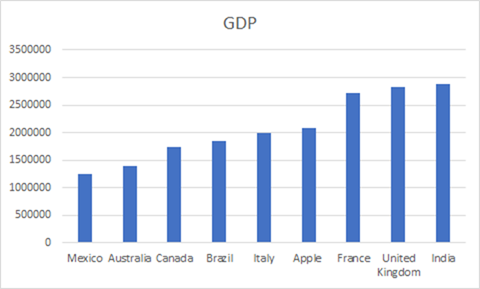
Market Cap of Apple versus 2019 GDP for selected nations
Now, bear in mind that just a few years ago, Apple was just above Mexico. So the trend is upward, then consider many nations are now forecasting a 2020 GDP slump of 10% or more. Apple may even be above the United Kingdom GDP before too long, perhaps even the end of this year.
Citizens are often frustrated by the apparent ability of the big corporations to dance rings about government tax collection using these methods that are unavailable to smaller businesses and individuals. For example, In the UK in 2010, HMRC waived a potential tax bill of £7bn from Vodafone. David Hartnett, the head of HMRC at the time, even later admitted that he might have made mistakes in some of his actions while settling potential high-yield tax disputes with multinational companies.
Also, Vodafone sold its stake in Verizon Wireless in 2013, to Verizon Communications in the USA. When it came to accounting for taxes, it claimed that a Netherlands Holding company owned the shares sold outside of UK tax jurisdiction and consequently paid no tax. This is all entirely legal, of course, and not a criticism of any corporation doing this, but the net effect of these kinds of deals on smaller businesses and citizens themselves is a bigger tax burden and an inability to compete fairly.
The concept of corporations goes back to Roman times and possibly still further. The basic idea is that a group of people got together to form a venture. Normally with profit-bearing motives. The word ‘corporation’ even comes from the Latin, ‘corpus,’ meaning ‘group of people.’ Part of the idea of corporations being that the venture could live on beyond the lifespans of normal people. Corporations really caught on as imperial trade ventures spread further and further afield, growing with the globalisation and taking us to the point today where these huge entities dominate national stock markets and their corporate footprint is everywhere. Most visibly seen in the products we buy and the logos we see all the time.
In terms of the relationship between governments, corporations, and the people, the view seems to be that the government is paternalistically representing the people and that corporations are off to the side regulated and taxed by the government, and people have the choice of whether or not to transact with them. In a way, they are almost considered to be a subset of the people, in the respect that many also own shares in the corporations, either directly or through their pooled investment schemes, like pensions. Also, people believe that the government is voted in by and represents the people, and the people only.
This old-fashioned view is questionable.