
Saturday, the coast again.
No plan beyond walking, listening to the detector, letting the ground decide what—if anything—it wanted to give up.
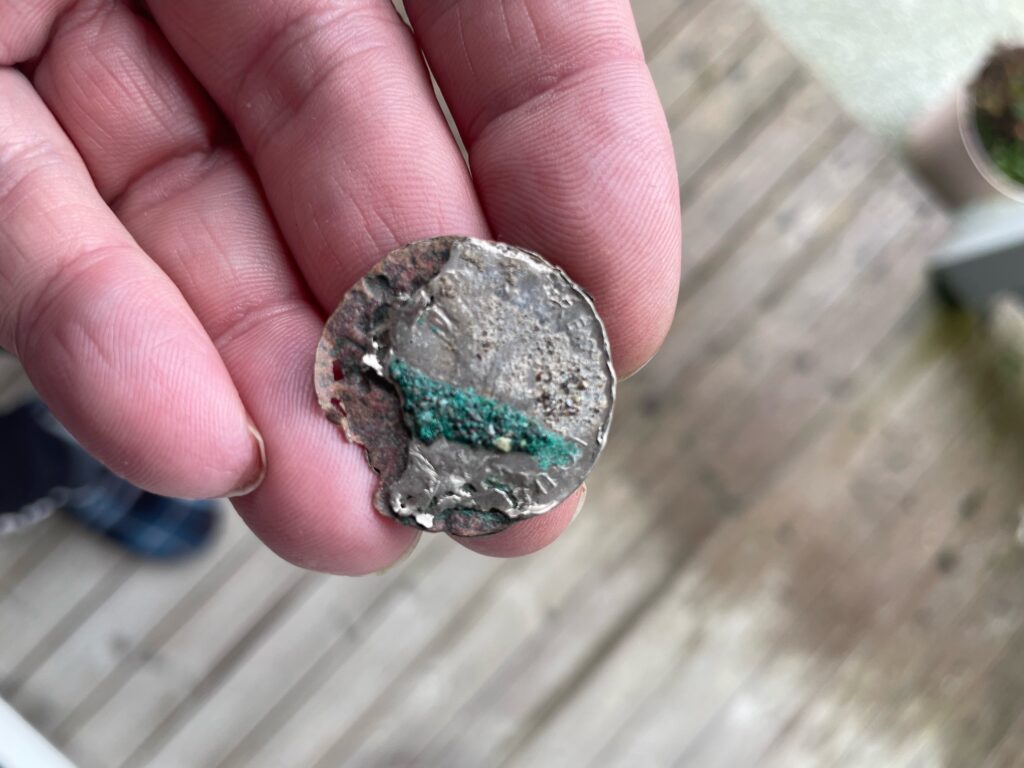
What came out of the sand didn’t look like a coin at first. Just a bent disc, flaking, scarred, almost tired. The kind of object most people would drop back where they found it.
But weight tells its own story.
Once cleaned enough to see structure rather than detail, the deception became obvious. A skin of silver, thin and failing, lifting away to reveal a copper core beneath. The green line—verdigris—cutting through it like a confession finally made under pressure.
This wasn’t damage.
It was design.
A forged silver coin. Almost certainly French. Georgian era. Made not to last, but to pass. Made to move quickly from hand to hand before anyone stopped to test it too closely.
Someone, two centuries ago, held this same object and decided it was “good enough”.
Money on the Move
Coins like this didn’t belong to collectors or kings. They lived in markets, taverns, ports. They moved with sailors, traders, soldiers—people in transit. People who valued speed over certainty.
Silver coinage worked because trust worked. Weight, colour, sound. That was enough. Most of the time.
Clipping the edges, plating copper, reducing fineness—these weren’t anomalies. They were symptoms. Wherever money moves, someone tries to make it lighter without anyone noticing.
This coin survived because it succeeded. For a while.
Eventually it failed, as they all do. The sea finished the audit that merchants once performed by hand.
Found, Not Explained
I don’t know whose pocket this sat in.
I don’t know what it bought, or when it was finally rejected.
What I do know is that it travelled. It crossed hands, borders, and probably arguments. It outlived the person who made it, and the person who passed it on.
Now it sits on a table, silver peeling away, copper exposed, the disguise no longer worth maintaining.
A small object, carried forward by chance, turning up exactly where journeys tend to end—at the edge of the water.
I put it aside with the others.
Not as a lesson.
Just as evidence that the road has always been like this.
I found it where journeys pause—at the waterline, where disguises no longer matter.