Category: The Great Reset (Page 3 of 4)

The Most Valuable Real Estate in the World?

In the prior post I described how it is expected Singapore has an important role to play as a potential new Switzerland in the New Financial World Order. It makes sense, an important banking centre smack bang in the middle of the power struggle, an oasis of neutrality and peace amidst the turmoil around. When playing the geopolitics game, we don’t really want everything destroyed, do we? It’s also interesting to think that this new banking centre doesn’t need to be as physically big as Switzerland. Thanks to the internet, much of the back office work can be outsourced to other regions, along with the need for clandestine visits by shady characters needing to transfer money who can now just get it sent to an account anywhere in the world within the blink of an eye. Singapore must have a good internet infrastructure. For example, the number of visits to this website by “Huawei clouds, Singapore” have bumped up dramatically this past month.

Certainly, Singapore is already playing up to it’s future role as a global chessboard grand master, with comments like this by their president, expressing concern at the possibility of a military confrontation between China and USA. If such a confrontation occurs, expect the losing side to fight it with one hand tied behind their back, in the style of the latter days of Nazi Germany, where troop concentrations and movements were telegraphed to the Russians by an unknown spy high up within the Reichs Chancellery. Nothing can be left to chance in order to get the correct result, can it?

The real test for Singapore comes soon, when the World Economic Forum comes to town in August 17-20, 2021. I suppose then, we may expect some kind of relative tranquility next few months, before the next stages of the agenda are laid out and taken away in bite-sized chunks by each representative back to their respective countries to digest and implement. As interesting as it might be to be a fly on the wall, who with any compassion could bear to witness the spectacle of a bunch of sociopaths uncaringly carving up the world as if it was a birthday cake, dividing the planned spoils with no regard for the people and places whose lives might be destroyed by their actions?

As always, there are other threats to the global plans. Things can never be 100% certain and when you look closely at that map of Asia, especially the region where Singapore has such an important role, you see a threat.
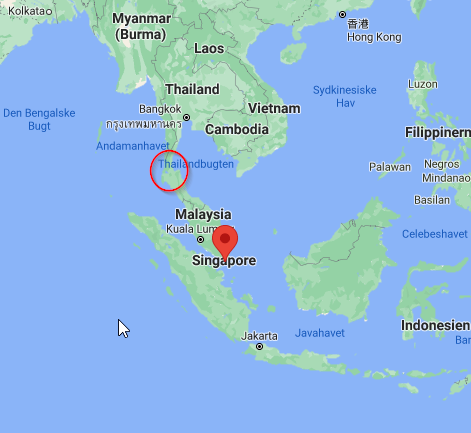
That narrow Singapore strait where one-third of the world’s shipping must travel through right now to head West to India, the Middle East, Africa and Europe could be under threat from a future development. Yes, if only someone had the foresight to consider building a canal across the part of Thailand that goes south as a narrow peninsular to Malaysia and Singapore. Actually, they already did and what’s more, it’s a bit of contentious situation, as this story laying out the potential for conflict if China did fancy getting involved in such an undertaking implies. That Foreign Policy, a reknowned non-neutral news source comes out with a story like this to stir the embers should also really get you thinking.

It wouldn’t be the first time this area has been important militarily. In 1941, Japan amassed it’s taskforce on the Thai side of the border with Malaya, ready for invasion. The British General even asked London for permission to carry out a pre-emptive strike, knowing the issues they would face defensively, once the task force breached the border and began advancing south through Malaya. Someone in London said no. The rest, including the surrender of 100,000 allied troops in Singapore some weeks later, while the heavy artillery faced uselessly the other way out to the sea, is history.

Of course the on-ground realities are different to how a global map shows it. There are always people living there. People who might be fond of the lives they live and not really be keen on moving. Certainly the building of the Panama canal was no picnic – especially not for the people who died building it and the locals dispossessed by building of it. This area also happens to be quite a large tourist-earning centre for Thailand. If only there was a way to play the long game and encourage the locals to move on, so you could start buying up the land ready for this ambitous long-term project. Hell, engineer the right circumstances and you might even be able to buy the land up quite cheaply compared to it’s true value.

Which got me thinking of Christmas 2004…

There are also some other interesting videos out there showing how it looks now and the abandoned properties. However, the one that really caught my eye is a 1946 experiment to create a Tsunami using a nuclear bomb.

Certainly if that was possible in 1946, the question must be asked, what was possible by 2004? Some people are even asking similar questions about the Fukushima Nuclear reactor incident.

So, taking this into consideration, how’s the Thai tourist industry doing right now? After all, if it’s doing well, there’ll be few sellers, but if things are bad there might be a lot of forced sellers. COVID-19 wasn’t a good tourist season, was it? Well, as of May 2021, if you want to visit you’ll need to quarantine for 14 days, which I can’t imagine does anything to get tourism going again and some locals may well be temped to move or see their assets as liabilities…
The New World Financial Centre

The British Empire and Sir Stanford Raffles in particular were a very shrewd lot. They identified a seemingly irrelevant island with a population of about 150 people as a piece of prime real estate back in 1817. What’s happened since is well-known of course, as the city of Singapore has developed into a major international trade and financial hub, with all the wealth and status that goes alongside that.

This place had always been on my to do list, so when a work trip in 2018 presented me with the opportunity for a one day stopover, I took it with both hands. While I didn’t actually sit down for a Singapore Sling, I did take a wander around the Raffles hotel complex and see the art deco railway station, where bullet damage from the 1941 Japanese invasion was still visible in some of the outer walls, before it probably disappears as the city modernises even further and obliterates the British symbols. The railway itself has already been moved to the North of the island and the future of the station seemed uncertain then, but ghosts were visible everywhere, as I peered through the locked gate into the past, surrounded by modern skyscrapers. I also saw the 1920s post office building, now a hotel, the main square in front of the Town hall where hundreds of thousands were executed by the Japanese and one of the world’s most expensive pieces of undeveloped real estate, The Singapore Cricket Club. I can only wonder how much longer that last piece of Imperial history will last. The battle of Singapore itself in 1941 has always fascinated me. For obvious reasons, it does not feature large in British history when World War 2 is mentioned, but will probably forever be Britain’s biggest military defeat, with a loss of 100,000 military personnel into Japanese captivity and subsequent death, along with the loss of two Battleships – The Prince of Wales and The Repulse.

I’d love to revisit some day on less of an intense schedule, but I sense my days of travel are numbered and I’ve used most of those numbers up. No matter, at least I can say I saw some of the world before all prison doors were locked with a resounding thud.

At the time, I was not ignorant of the island’s position as a major trade route and centre of wealth. Goldmoney and Bullionvault have offered Singapore as a precious metals storage location for years. However, it’s only when you are actually there on the ground, staring up at the impressive skyscrapers that you really understand how the wealth and energy is migrating from the old world to the new.

It’s interesting how stories coincide once more and get you thinking on a particular route. A few weeks ago, I expressed the view that Bitcoin is a distraction, or a preparation for a release of a new monetary system to replace the Petrodollar that has existed since 1971, the year of my birth, the introduction of decimalisation to the UK, the closing of the Gold Convertibility window in the USA and the official founding of the World Economic Forum – more on the last one later. In my view, the coming of digital currencies is inevitable and they may not be nice, with features such as time limitation (spend it or lose it) and extra credits available only to those who follow the rules of society (get the jab or don’t eat meat?). However, for them to be truly accepted, they will need to engineer a collapse of the current system and when that system collapses, every monetary system change ever has had to promise some kind of gold backing to get the public onside.

Historically, the old world still rules the precious metals world, with familiar locations like New York, London and Switzerland being where most of that trade is transacted. As the old world declines further and the new world rises, an Asian powerhouse, one with independence, strong defences, good shipping links and a robust financial system to trade gold and silver is required. There’s no doubt on these metrics that Singapore ticks all the boxes.

What really triggered it was a story mentioning the huge new precious metals facilities being developed in Singapore. It’s not the first time media, including the BBC, have reported on this. Yes, it looks possible a new world currency backed by gold/silver is coming and it will all be stored in Singapore, perhaps with an offshoot for Europe in London. On this, Brexit suddenly makes more sense – a European nation outside EU control, a defendable island where the wealth can be stored as the mainland descends into destruction. The Corporation of London certainly has a pedigree line of survival and growth, regardless of the general situation in the country. You may laugh, but despite a recent short period of comparative peace, Europe has a long, long history of huge wars for resources and after a year of rewarding people for doing nothing, while the continent becomes ever-more dependent on a few producers to carry the mass on their shoulders cracks may appear and Atlas may yet shrug.

When you think about it, it’s interesting how Switzerland always managed to remain neutral during the many European wars of the last few centuries. It becomes clearer why when you are aware of the high levels of banking secrecy Switzerland has historically maintained regarding account holders and fund sources. Consider also how much plundered loot found its way to Switzerland during World War 2. Why, the World Economic Forum itself is even based in Switzerland and Klaus Schwab, it’s apparent founder, was born in Germany in 1938, just before World War 2 began. I’d be interested to learn more on his family history, and this article is something of a primer. Having conducted their meetings in Davos, Switzerland for the entire history of the organisation, they are now holding their first-ever meeting in Singapore in August, 2021.

On closer examination of the Asian map, Singapore is crucial to all trade heading from China, Japan and Korea etc to India then onwards to Europe. Ships can only sail through one narrow strait. The Evergreen in the Suez canal feels like the first visible supply disruption which will expose Europe to how reliant it has become on foreign imports of essentials. Perhaps when those containers do finally arrive, they will be loaded up with precious metals for the return trip as Europe is stripped bare?

Meanwhile, almost everyone in Europe wanders around like idiots, wearing masks and continuing to following “official advice”, not laws on all kinds of things that really are basic human rights, like seeing family and friends, or conducting mutally beneficial transactions with other human beings. Blithely unaware of the probable imminent end of their way of life. You know, that “way of life” that you have been told terrorists hated so much that it needed to be protected, yet was immediately signed away the moment you got told a new virus with a 99.6% survival rate hit?

What do I know really? If I was better at these things I wouldn’t be working in an office following the limitations of my school programming, but on the basis of these jigsaw pieces slotting together, perhaps we should be investing in Singapore. Especially banks if it is going to be the new Switzerland after the World Economic Forum meeting. Not to say there won’t be bumps along the way – one other thing about that map is the seeming inevitability of a conflict between the old world powers and the new. That same Asian map shows how China is totally hemmed in from the sea because the USA controls Japan, South Korea, Taiwan and the Philippines. If China could punch through and take Taiwan or part of the Phillipines, they could control the Pacific. A war is brewing. I note, for example, that the UK recently sent their aircraft carrier to the China sea. A war in which Singapore will remain an agreed neutral by all parties, just like Switzerland did during the last century, but a war in which the destruction and rewards to the victors may well be huge and end up on this small island nation.

3 – and That’s The Magic Number

On the 3/3 a woman called Sarah, aged 33, was murdered by a man in London. A policeman, as it happens. I don’t claim the credit for spotting that one, but it does lead into some interesting coincidences, especially considering how the story has been used way beyond being a murder case that should be investigated with respect for everyone until…no, innocent until proven guilty and policing with logic instead of emotion seems to have gone by the wayside.

Amongst the media circus for everyone to invest their emotion in, there were even calls from some for a curfew for all men to be home by 18:00. That supposed believers in a free society think it’s okay that one incident like this should ride on the rights and livelihoods of 60 million-plus people is bizarre. However, it fits with the whole Corona regime that we are entering a Minority Report-style world where everyone is believed to be infected unless proven otherwise and now, everyone is believed to be guilty unless proven otherwise. Anyway, didn’t they miss the other big question it raises – who’s going to enforce this curfew if something so extreme was ever allowed to happen? The Police?

If there is anything to really be gained from this story, it’s surely that the police themselves cannot be trusted. I fear however, that even this will be used against humanity. All it needs is someone to say humans can’t be trusted to police each other…if only there was some way a computer, with it’s impeccable logic and lack of prejudice could do the job. Maybe a robocop or robodog? Let’s just forget for a moment that computer software is always programmed by humans, with huge margin for error. Robocop from the 1980s was rather prescient in seeing how it could go.

Meanwhile, journalism seems keen to focus on the alleged perpetrator still receiving his salary while suspended from his job. Even helpfully repeating across the globe how he will still receive his at least £33,000 salary. Here, here and here. What a bizarre figure to concentrate on. Unless…..dipping into the world of freemasonry, Google tells me there are 33,000 lodges worldwide, with 33,000 members in many lodges. Continuing the search theme, other newsworthy stories further feed the conspiratorial fires. It’s amazing how many COVID-19 injections seem to be delivered in batches of 33,000. Utah, for example, a home of alternative religion and mystic rites certainly seems keen on the magic number. Gibraltar just completed it’s injection programme too, although this media source doesn’t seem to be in on the numerical importance. Then we have the shooting in Georgia, also successfully being used to whip up racial and gender division where there previously was none, with this story helpfully telling us that the alleged perpetrator came from Woodstock, Cherokee county with a population of…33,000.

Why am I bringing all of this up, do you ask? Returning to the world of finance, let’s finish with the biggest 33,000 financial sign going. Amongst all these 3’s the world’s biggest stock market, the DOW Jones Industrial Average hit an all-time high last week. I don’t need to tell you what it was before you visit the link, do I? The Federal Reserve even helped out, the story tells us, with soothing words and promises of further stimuli to keep the party going, despite the reality of every economic indicator. I find myself wondering if words and actions may diverge soon. At least for a little while until other parts of the agenda are enacted.

I shall leave the final words to De La Soul, with their 90’s hit, although apparently that was a cover of Schoolhouse Rock / Bob Durrough in 1973. Meanwhile, we can all ponder what the 33,000 signifies to those in the know, along with asking the how and why of Wayne Couzens’ black left eye.

Bitbubble

Last night was one of those nights where you wake up and things occur to you. I’ve had quite a few of those lately, but this one seemed especially illuminating. For a while now, we’ve had the word bubble planted in front of us by the media for quite a while to convince us stock markets, bond markets, commodity markets and biggest of all, cryptocurrencies are too high and may be about to crash.

Using reverse psychology, you should wonder if there really is a bubble. After all, a real bubble happens when everyone is too carried away by the emotion and success to recognise the bubble for what it is. In fact, bubbles don’t normally get identified until long after they pop. In hindsight, a graph usually makes it clear and everyone who once yelled loudly about their success now remains quiet and tries to forget the whole sorry episode.

Perhaps the one where you could say the graph seems to show a bubble, is Bitcoin. While I regret not being in on the Bitcoin boom, I’m still not convinced and find myself on the side of Peter Schiff and Jim Rogers, versus such other illuminaries as Doug Casey and Robert Kiyosaki. Yes, billions are being made and yes, we can agree fiat currencies are in massive decline. However, to me, the best medium to avoid that is the precious metals, with thousands of years of history to prove it, not electronic bits on a screen with no intrinsic value. Of course, the blockchain technology, decentralisation and ability to pay without banks are excellent, but it all runs on establishment hardware. Beginning with your smartphone, then the networks that pass your data across the world. As the establishment gets better at tracking, they will undoubtedly find ways to switch you off if they want to. There are certainly some fascinating debates out there to watch on the subject between these knowledgeable and successful people. Meanwhile, stories like this, about a German who won’t give the police his password and would rather sit in prison, remain amusing and stick two fingers up to the powers that be.

I am certainly an interested observer. Even the mysterious Satoshi Nakamoto, who supposed started up Bitcoin is an enigma. For some reason, his name reminds me of the government department, the NSA (National Security Agency) and it’s always seemed strange that organisations with a global reach and unlimited funds are unable to track down the person who started it all. As an adult, you know that sometimes the best way to keep a child or dog occupied is to throw them a ball and part of me has wondered lately if that’s exactly what’s happened here. Throwing a ball to keep people busy and distract them from the best investments, while you clean up on the cheap.

Take, for example, the recent purchase by Tesla of $1.5 Billion worth of Bitcoin. Why would they do that, you might wonder? Whatever reasons are given, I find myself doubting they are the full truth. Then, we hear that Apple may also buy Bitcoin. Both stories helpfully plugged on mainstream media, to ensure maximum public reach.

So why are they buying?

Last night was my own Eureka moment. On a yearly basis, there isn’t enough silver mined to meet demand. Only about 80%, with the rest met by recycling. Fair enough, excellent reuse, but for how long will there be enough scrap silver to go around, and, if a sniff of inflation came around, how many of those recyclers would be willing to sell their metal at the current prices? It led me to get thinking about the products of Tesla and Apple, and the amount of silver they consume yearly. In the case of Tesla, one electric car consumes 1 kilogram of silver. It doesn’t sound like a lot, but if they make one million cars a year, then they will consume 5% of world silver demand. To put that in perspective, Ford alone produced 4 million cars last year. When it comes to Apple, I am grateful to this excellent infographic for explaining it all very clearly, albeit it from 2013. I can only guess that bigger iphones means even more metal in there.

Here’s my view – the public has been thrown a ball to play with. Indeed, it may continue to shoot up and entertain us all, the same way the Dutch went wild for Tulip bulbs in Amsterdam in the 1600s, and for a while, we may all feel ourselves rich or stupid for not participating. Indeed, some will walk away with fortunes. The majority probably won’t, however.

Meanwhile, the elite can stock up on the proven store of value and have a good laugh as many lose everything and are forced to succumb to The Great Reset.

UK Government Borrowing in the Time of Corona

The BBC lays the amount of new money created in the UK, during the Corona crisis. To spell it out :-

“Since the beginning of the financial year in April, government borrowing has reached £214.9bn, £169.1bn more than a year ago.

The independent Office for Budget Responsibility (OBR) has estimated it could reach £372.2bn by the end of the financial year in March.”

https://www.bbc.com/news/business-55013192

The natural consequences of this? Inflation, even if it takes a few years for the currency to begin circulating, or the death of the pound? Take your choice.

Stock Markets and Gold

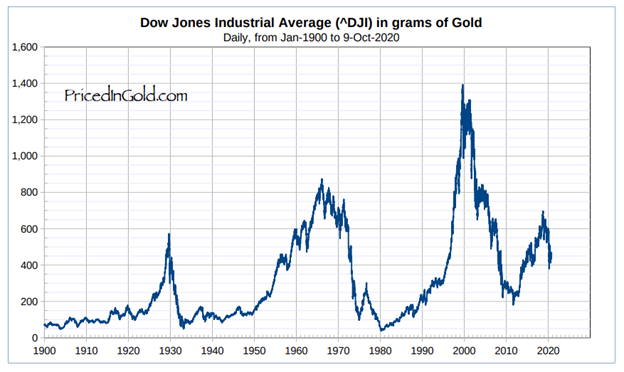
Now for more news, your stock market investments may be worth under one-third of their value in 2000.  Gasp.  Yes, the gain of the last 20 years has been illusory.  For sure, some countries and some market sectors have done better than others, but for the USA main index, this is exactly what has happened.

(Chart: DJIA priced in ounces of gold)

Even if large corporations prosper, the US DJIA stock index and gold have a history of a near meeting when a financial crisis bottoms out. Currently, the DJIA is worth around 14 times the price of an ounce of gold. In 1932 and 1980, just over one ounce of gold bought the DJIA. Whether a large stock market crash achieves that, as was the case in 1932, or inflation pushing up the gold price, as was the case in 1980, it may be destined to happen again.

Oil and Gold

Oil is still one of the biggest building blocks of life.  Regardless of whether you now work from home instead of driving to work every day in the gas-guzzler or not.  It’s used in everything – fuels, plastics and pharmaceuticals, to name a few.  In fact, if you now work from home, chances are you’re turning up the winter thermostats a bit more often than you would at work.  You’re probably also buying a lot more food from the supermarket, most of it encased in plastic packaging.  Even if your heating system is not oil-based, oil remains one of the main fuels available for generation of electricity, and could well do so for many, many years, regardless of how many windmills they build.

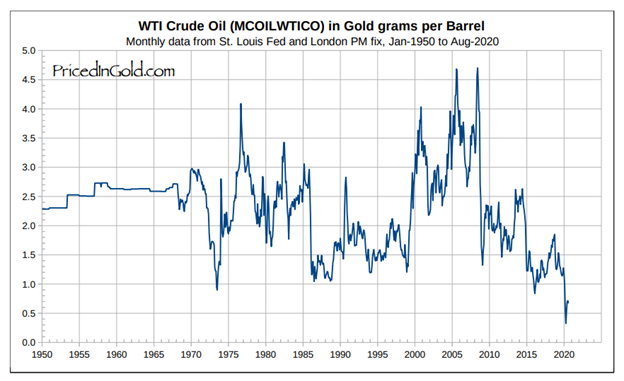
So, the good news.  You’ll be pleased to hear is that oil is at an all-time low, when measured against gold.  Luckily enough, since with your earnings being one-sixth of the 1970 value, you may not be able to afford to keep the house warm or drive a car otherwise.  Any apparent price rises you see at the pumps are merely an inflation of your fiat currency.

Now for the bad news, can it continue?

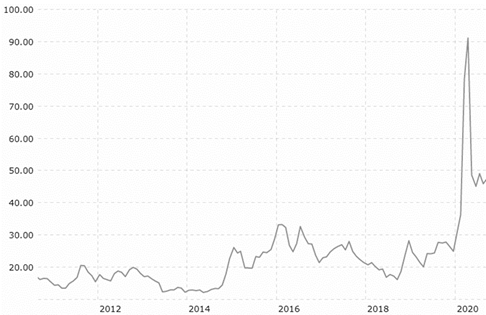
Maybe not.  For many years, gold and Oil actually maintained a near 10:1 ratio relationship.

(Chart: Gold/Oil ratio 2010 to 2020)

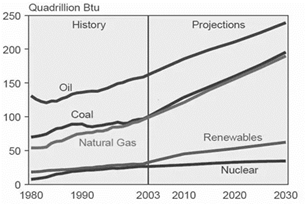
As the chart shows, this relationship has become distended as a result of the Corona crisis. There’s now a near 50:1 relationship as of August 2020. This may imply oil is actually quite cheap, gold is expensive, or that the ratio no longer holds. There has been a multitude of media articles heralding the death of oil.  However, it seems to have missed the attention of many that all of this data – everyone’s Facebook posts, Instagram images, or cloud software solution is stored on a server somewhere that requires electrical power to run. For sure, in the case of one Instagram post, that electrical consumption is miniscule, but multiply it across a world of 7 billion people, and you get an idea now of the immense electrical power required. Oil, natural gas, and coal are still heavily used in electrical power generation across the globe.

(Chart: Actual and predicted power sources to 2030)

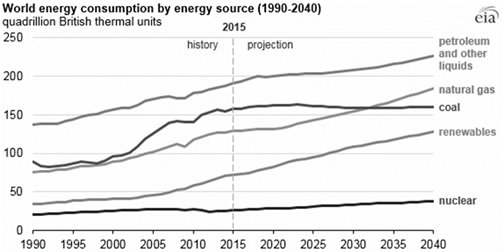
The eagle-eyed among you may have spotted the chart dates from 2003. This was deliberate since more recent data shows it to be correct. If so, the future trend for oil consumption is still upward.

(Chart: Energy consumption to 2040)

So, and this is only a question, not investment advice, maybe oil itself is not finished yet as an investment.  If not, could it revert back to the 10:1 ratio with gold and if so, at what price for both?

Housing and Gold

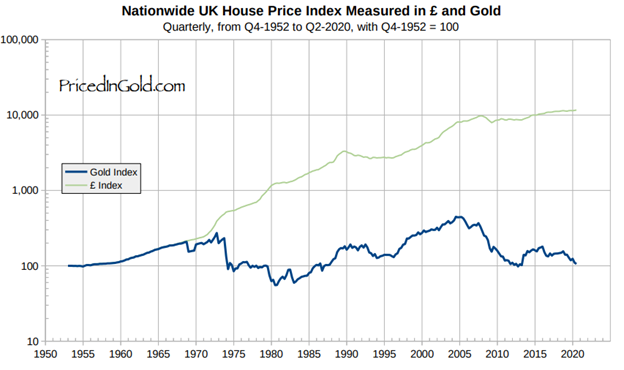
Now for some big news.  If you live in the UK, your house topped in value in 2005 and has been falling ever since.  In fact, it’s now about one-quarter of what it was worth then.  What?  I hear you say.  Okay, yes, in fiat currency units it has gone up, but measured in gold, it has fallen dramatically.

Measured this way, house prices are very close to the 1950 mean.  However, with the Corona crisis still in full swing, employment uncertainty for many and wages still at one-sixth of their 1970 value, it’s entirely possible the market could still have a lot further to fall.  Conversely, if something happens to get wages closer to the mean or inflation rises, well, they could easily move upwards in fiat currency terms especially.

In this case, the housing market is hard to exit, unless you prefer the uncertainty of renting.  Everyone needs to live somewhere.

Textiles and Gold

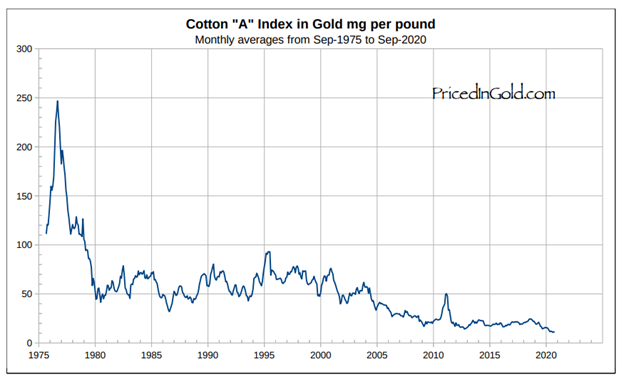
Clothes are really cheap right now, as retailers dump tons of unsold stock from the 2020 fashion ranges onto the market at bargain prices. If you already have enough clothes, fine, but if not, it might be a good time to ensure you do, especially clothes to see you through cold winters. With this glut, it’s hard to know what will happen to all elements of the clothing supply chain in the future: Cotton farmers, Garment manufacturers, and clothing retailers.

The low price of cotton has already made it hard for growers in countries like India to turn a profit and it’s hard to know how they are coping with this huge change in market conditions.  There’s been talk of suicides in the media.  With cotton at an all-time low, we can assume that prospects are not great for some cotton farmers.

Food and Gold

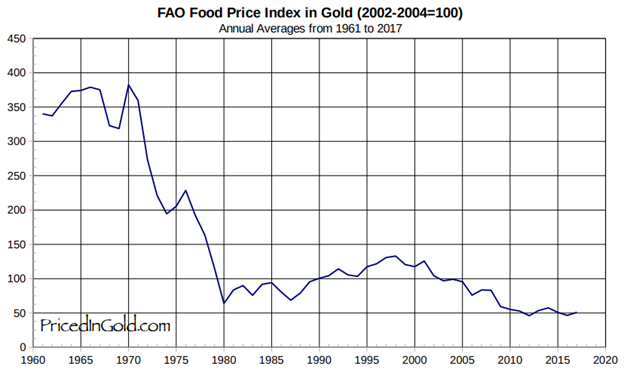
100 years ago, the average household spent up to 50% of its income on food. Today, that figure is nearer 10%, giving us all more disposable income for consumer goods, bigger mortgage repayments, and exotic holidays.  Food is cheap, almost too cheap, in fact.  As some farmers struggle to turn a profit and big supermarkets control the supply chain.

(Chart showing food prices as a proportion of income)

Of course, some of this is due to technological improvements in farming and manufacturing, but much of it is due to fiat currency inflation versus gold.  Perhaps it can’t last forever – we may well already be being prepared for future food shortages and increases in food prices. You may have already noticed shortages during the crisis or increases. On a personal level, visiting the supermarket regularly, a 20-25% increase in fruit, vegetables, and dairy products has occurred since March 2020, when Corona began. That’s interesting, as these products are all the ones with the shortest shelf life, that are most immediately impacted by price rises. Others, like dried, tinned and frozen goods, may be in huge stock at warehouses down the supply chain behind the supermarket facade, and price rises may take longer to feed through. Observe these headlines from recent times, as to what they may be planting the seed in your head to germinate for:-

“UK potato farmers fear another washout for this year’s crop. “

The Guardian, August 2020

“Bread price may rise after dire UK wheat Harvest.”

BBC News, August 2020

“Coronavirus: Meat shortage leaves US farmers with ‘mind-blowing’ choice.”

BBC News, May 2020

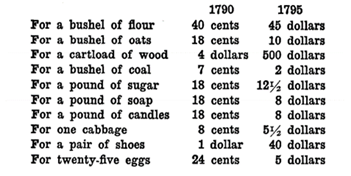
If you wonder how far food prices can rise during a monetary crisis, then here is an example of prices from “Fiat Money Inflation in France,” an excellent study of the hyperinflation that occurred there during the French revolutionary times, which coincide with the decline of the French empire before the handover to Great Britain.

Now, how well covered are you for those kinds of price rises in basic commodities, the essentials of life?

« Older posts Newer posts »

© 2026 InvestGold

Theme by Anders NorénUp ↑